Sophia

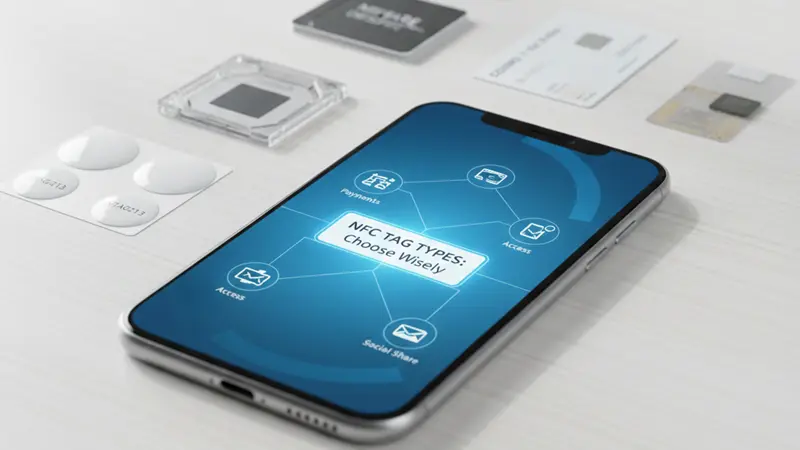
NFC tag types are five technical categories defined by the NFC Forum. They describe how an NFC tag stores NDEF data, communicates with phones, and fits different applications such as URL sharing, access control, product authentication, industrial tracking, and smart packaging.
For most marketing, product-labeling, and everyday smartphone use, NFC Forum Type 2 tags such as NTAG213, NTAG215, and NTAG216 are the most common choice. For secure access or identity applications, Type 4 tags are usually a better fit. For industrial or long-read applications, Type 5 tags based on ISO/IEC 15693 may be more suitable.
This guide compares NFC Type 1, Type 2, Type 3, Type 4, and Type 5 tags by standard, memory, chip examples, smartphone compatibility, and real-world use case.
The five NFC Forum tag types are not physical shapes. A tag can be made as an NFC sticker, card, wristband, key fob, label, or anti-metal tag. The “type” refers to the technical format behind the tag, including its standard, memory structure, command set, and NDEF compatibility.
| NFC Tag Type | Main Standard / Interface | Common Chip Examples | Typical Memory | Phone Compatibility | Best For | Recommendation |
|---|---|---|---|---|---|---|
| Type 1 | NFC-A / Innovision Topaz | Topaz 512 | Low | Limited today | Legacy simple tags | Rarely used for new projects |
| Type 2 | NFC-A / ISO 14443A | NTAG213, NTAG215, NTAG216, MIFARE Ultralight | Low to medium | Excellent on iPhone and Android | URLs, smart labels, marketing tags, product packaging | Best general-purpose choice |
| Type 3 | NFC-F / JIS X 6319-4 | FeliCa | Medium | Good in supported regions/devices | Transit, payments, Japan/Asia ecosystems | Use for FeliCa-specific projects |
| Type 4 | NFC-A/B / ISO 14443A/B | DESFire, JCOP, secure smart-card chips | Medium to high | Excellent | Access control, identity, payment-like security, secure cards | Best for secure applications |
| Type 5 | NFC-V / ISO 15693 | ICODE SLIX, ST25TV | Medium | Supported by many modern phones | Libraries, industrial labels, asset tracking | Best when ISO 15693 is required |
NFC tag types are closely related to existing RFID and smart-card standards. Understanding this mapping helps buyers choose a tag that works with smartphones, readers, and existing systems.
| NFC Standard / Term | What It Means | Related NFC Tag Types | Common Use |
|---|---|---|---|
| NFC-A | NFC communication based on ISO/IEC 14443 Type A | Type 1, Type 2, Type 4 | Most NFC stickers, labels, cards, NTAG chips |
| NFC-B | NFC communication based on ISO/IEC 14443 Type B | Type 4 | Smart cards, ID cards, secure applications |
| NFC-F | FeliCa-based NFC technology | Type 3 | Transit, payments, Japan/Asia ecosystems |
| NFC-V | NFC mode based on ISO/IEC 15693 | Type 5 | Industrial tags, libraries, asset tracking |
| ISO/IEC 14443 | Proximity card standard, short read range | Type 2, Type 4 | Cards, access control, NFC phones |
| ISO/IEC 15693 | Vicinity card standard, longer reader range | Type 5 | Asset tracking, libraries, industrial labels |
| NDEF | NFC Data Exchange Format | Type 1–5 when formatted | URLs, text, vCards, app links, records |
In simple terms, NFC-A Type 2 is usually the safest choice for consumer smartphone interactions. Type 4 is preferred when the application needs more security or smart-card behavior. Type 5 is useful when the project already uses ISO/IEC 15693 or needs industrial-style RFID compatibility.
The NFC Forum’s classification system exists for interoperability. But beneath the technical specifications are practical differences in smartphone support, memory, security, read range, and production cost. Here is how each type works in real projects.
Type 1 tags are less common in new deployments. If you are starting a new project, Type 2 is usually a safer and more widely supported choice.
NFC Forum Type 2 tags are the most widely used NFC tags for everyday smartphone interactions. They are commonly used in NFC stickers, NFC business cards, product labels, posters, smart packaging, review cards, and customer engagement campaigns.
| Chip | Usable Memory | Best Use | Notes |
|---|---|---|---|
| NTAG213 | About 144 bytes | Short URLs, simple landing pages, product labels | Best low-cost default for most projects |
| NTAG215 | About 504 bytes | Longer records, authentication-style use cases, gaming-style data | More memory than NTAG213 |
| NTAG216 | About 888 bytes | Longer vCards, multiple records, richer NDEF data | More memory, but not always better for tap speed |
For most projects, NTAG213 is enough if the tag opens a short URL. If you need to store more data directly on the chip, NTAG215 or NTAG216 may be useful. However, for marketing and product use, it is often better to store only a short URL on the NFC tag and keep the detailed content on a web page.
Need genuine NXP chips in a ready-to-order card format? See our NTAG 213/215/216 RFID cards for bulk and custom orders.
For projects requiring reliable performance on metal surfaces, use specialized NFC anti-metal tags that include a ferrite layer to reduce signal interference.
Type 3 tags are powerful in FeliCa-based ecosystems but are less common for global marketing, packaging, and product-labeling projects. Unless your project specifically requires FeliCa compatibility, Type 2 or Type 4 is usually more practical.
Type 4 is the better choice when the application needs smart-card behavior or stronger security. It is more complex than a simple Type 2 sticker, but it is often the right direction for access control, membership systems, identity cards, and secure NFC cards.
Type 5 tags are based on ISO/IEC 15693, also known as NFC-V. Dedicated industrial readers can read ISO 15693 tags at a longer distance than normal NFC phone taps. However, smartphone read range is still short, so do not choose Type 5 only because you expect long-range phone scanning.
| If your project needs… | Choose… | Why |
|---|---|---|
| A smartphone tap to open a URL | Type 2 / NTAG213 | Low cost, excellent phone support |
| More memory for longer NDEF data | Type 2 / NTAG215 or NTAG216 | Larger memory than NTAG213 |
| Secure access control or identity cards | Type 4 | Better fit for secure smart-card applications |
| Industrial or library-style RFID compatibility | Type 5 | Based on ISO/IEC 15693 / NFC-V |
| FeliCa transit or regional payment ecosystem | Type 3 | Built for NFC-F / FeliCa systems |
| Use on metal surfaces | On-metal NFC tag, usually Type 2 or Type 5 | Ferrite layer helps prevent signal interference |
If you are not sure which NFC tag type to choose, start with the application first: smartphone marketing, access control, industrial tracking, product authentication, or asset management. The tag shape, chip, memory, and material should all follow the use case.
Access control, employee badges, and identity cards need Type 4. DESFire, JCOP, and other secure smart-card chips support mutual authentication, so the reader has to prove it holds the correct key before the tag responds. That same authentication is why DESFire-based cards resist the consumer cloning tools that can copy a simple Type 2 tag in seconds. A Type 2 chip like NTAG213 stores its data openly and is not built for this kind of security, so it is a poor fit for door access or badge systems.
Payment-adjacent and identity-verification projects share the same requirement as access control: encrypted memory and mutual authentication. Type 4 (DESFire, JCOP, and other secure RFID card chip options) is the right category here, not Type 2. Type 2 tags are built for open, read-anywhere use cases like marketing and product labeling, not for applications where the tag needs to keep a secret from the reader.
Inventory, asset tracking, and library-style deployments usually fit Type 5 (ISO/IEC 15693, NFC-V), especially once dedicated industrial readers are already part of the setup and need a longer read range than a phone tap provides. Compare RFID frequency options if the project also needs to fit an existing LF or UHF reader infrastructure. If the deployment leans closer to consumer smartphone scanning than fixed industrial readers, Type 2 is still the more phone-friendly option even for tracking use cases.
NFC tag type and NFC tag format are different concepts. The NFC Forum tag type describes the technical standard, such as Type 2 or Type 5. The physical format describes how the tag is manufactured and used.
Common NFC tag formats include:
For example, an NFC sticker and an NFC card can both use an NTAG213 Type 2 chip. A Type 5 chip can be made into an industrial label or asset-tracking tag.
Phone antenna position affects scan reliability. On many iPhones, users should tap near the top-back area of the phone rather than the center of the screen. Very small NFC tags can be hard to scan consistently, so larger tag diameters are usually better for consumer-facing projects.
Standard NFC tags usually perform poorly on metal because metal interferes with the antenna. For metal surfaces, use an on-metal NFC tag with ferrite shielding. This is especially important for industrial assets, equipment, metal packaging, and server racks.
Bigger memory does not automatically mean a better NFC experience. For a simple URL, a smaller NTAG213 is often faster and more reliable than storing too much data directly on the chip. For most marketing and product-labeling projects, put the detailed content on a landing page and store only the short URL on the NFC tag.
The five NFC Forum tag types are Type 1, Type 2, Type 3, Type 4, and Type 5. They define how an NFC tag communicates, stores NDEF data, and works with phones or NFC readers.
For most smartphone projects, NFC Forum Type 2 tags are the best starting point. NTAG213, NTAG215, and NTAG216 chips are widely supported by both iPhone and Android devices.
An NFC Type 2 tag is an NFC-A tag based on ISO 14443A technology. Common examples include NTAG213, NTAG215, NTAG216, and MIFARE Ultralight chips. Type 2 tags are commonly used for NFC stickers, cards, labels, posters, and smart packaging.
Type 2 tags are usually simpler and lower-cost, making them ideal for URLs, labels, and marketing interactions. Type 4 tags are more suitable for secure smart-card applications such as access control, identity, and payment-like systems.
NFC Type 5 is based on ISO/IEC 15693, also known as NFC-V. It is often used in libraries, industrial tracking, asset labels, and applications that need ISO 15693 compatibility.
No. NFC tag type refers to the technical standard, while sticker, card, wristband, key fob, and label refer to the physical form. The same Type 2 chip can be made into a sticker, card, wristband, or key fob.
Choose NTAG213 for simple URLs and most marketing tags. Choose NTAG215 or NTAG216 if you need more memory for longer NDEF records. For most business use cases, storing a short URL on NTAG213 is more reliable than storing too much data directly on the chip.
Standard NFC tags usually perform poorly on metal because metal interferes with the antenna. For metal surfaces, use an on-metal NFC tag with a ferrite layer.
If you already know your application but are not sure which NFC tag type, chip, or format to choose, send us your project requirements. ZealTag manufactures RFID and NFC tags, custom NFC cards, wristbands, labels, and anti-metal tags for different materials, chip types, and application environments.
Request an NFC tag recommendation based on your use case.