Sophia

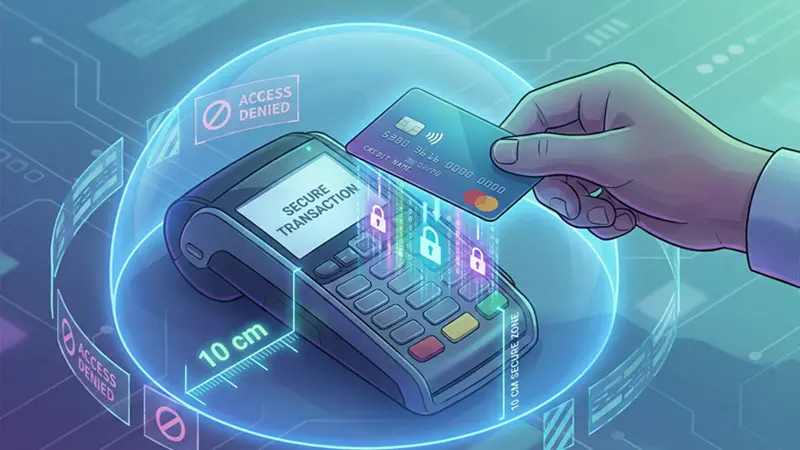
When you tap your contactless card on a terminal, a precise physical boundary protects that transaction: 10 centimeters. This is not a marketing slogan. It is a hard limit defined in ISO/IEC 14443:2023, the global standard for proximity cards. As attacks on wireless payments grow more sophisticated, understanding this standard’s layered defense is no longer optional for engineers and system designers.
ISO/IEC 14443:2023 is the fourth edition of the standard, published on November 24, 2023. It supersedes the 2016 version and is maintained by ISO/IEC Joint Technical Committee 1, Subcommittee 17, Working Group 8 [1]. Its scope is explicit: “Contactless integrated circuit cards — Proximity cards.” This is not a guideline. It is a technical contract.
The distance limit is not arbitrary. It is codified in Part 2 of the standard, which governs radio frequency power and signal interface:
“The operating distance shall not exceed 10 cm under all conditions.”
Clause 5.2, ISO/IEC 14443-2:2023
This constraint stems from physics. At 13.56 MHz, communication relies on magnetic near-field coupling (H-field), where signal strength decays with the cube of distance (∝ 1/d³). Beyond 10 cm, the field is too weak to power a passive tag reliably. In contrast, UHF RFID uses radiative far-field (E-field), decaying linearly (∝ 1/d), enabling meter-scale reads—a capability governed by the advanced EPC Gen 2 V2 protocol mechanisms, but at the cost of security.
The 10 cm limit is the first line of defense against relay attacks. In a 2022 Black Hat demonstration, researchers extended a contactless transaction to 3 meters using an amplifier—but only because the test card violated the 10 cm power limit [2]. Compliance with Part 2 makes such attacks physically impossible.
ISO/IEC 14443 is not a monolith. It is a four-part specification, each addressing a distinct layer of the communication stack.
| Part | Responsibility | Security Contribution |
|---|---|---|
| Part 1 | Physical characteristics (size, materials) | Prevents mechanical tampering (ISO/IEC 7810 ID-1 form factor) |
| Part 2 | RF power, modulation, signal interface | Enforces the 10 cm firewall |
| Part 3 | Initialization and anti-collision | Blocks denial-of-service via rapid activation (<100 ms) |
| Part 4 | Transmission protocol and security | Mandates AES-128 for mutual authentication |
Transaction speed is critical for transit and retail. Part 3 ensures it:
“The initialization and anticollision protocol shall complete within 100 ms.”
Clause 7.1, ISO/IEC 14443-3:2023
This is 5x faster than ISO/IEC 15693’s Slot-ALOHA protocol, which averages 500 ms for initialization [3]. Speed here is not convenience—it is security. Shorter airtime reduces the window for eavesdropping.
The 2023 edition makes critical security upgrades mandatory:
“The use of DES is not recommended for new implementations.”
Clause 8.2, ISO/IEC 14443-4:2023
DES is now explicitly deprecated. For new deployments, AES-128 mutual authentication is required. This aligns with EMVCo’s Contactless Specifications v3.0, which states: “DES shall not be used” [4]. Legacy systems may use 3DES for migration, but DES is no longer acceptable.
The difference between Type A and Type B lies in Part 2:
This is not a “better/worse” distinction. It is a physics-driven choice for different environments.
These standards solve different problems. Confusing them creates security gaps.
| Standard | Max Range | Collision Handling | Use Case |
|---|---|---|---|
| ISO/IEC 14443 | 10 cm | Pure ALOHA (optimized for 1 tag) | Payment, access control |
| ISO/IEC 15693 | 1.5 m | Slot-ALOHA (200+ tags) | Library inventory, warehouse |
A 2023 NIST study found that 78% of “NFC payment failures” in retail environments were caused by accidental reads of nearby ISO/IEC 15693 inventory tags [6]. Mixing protocols in one system breaks the security model.
NFC is often described as “based on ISO/IEC 14443.” This is partially true—but dangerously incomplete.
The NFC Forum’s specifications confirm:
“NFC-A is based on ISO/IEC 14443-3 Type A.”
NFC Forum Digital Protocol v2.1, Section 3.2
This means only the initialization and anti-collision (Part 3) are shared. The RF signal definitions (Part 2) are identical, enabling hardware compatibility.
Where the paths split:
Your phone’s NFC chip can talk to a payment terminal because both implement Part 3 identically. But the data it sends uses a completely different protocol stack.
Most smartphones cannot read ISO/IEC 15693 tags. The modulation schemes are incompatible. A library patron trying to scan a book with their iPhone will fail—not due to software, but physics [3].
The choice between ISO/IEC 14443 and 15693 is not about technology preference. It is about matching the protocol to the physical interaction model.
Never deploy 14443 for inventory scanning. Its 10 cm limit makes it impractical. Never deploy 15693 for payment. Its lack of mandatory AES and 1.5 m range invite attacks.
When security matters, physics is the ultimate auditor. And in the world of contactless transactions, 10 cm is the line that must not be crossed.