Sophia

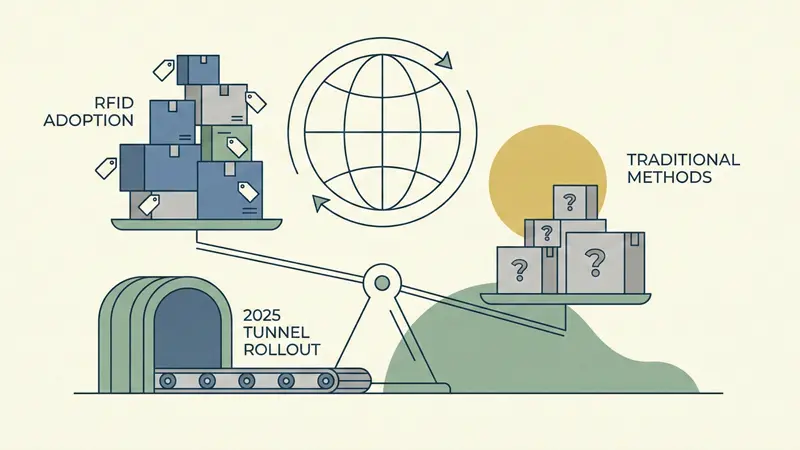
On March 10, 2025, ShinWon Fashion Group announced it will deploy its in-house developed RFID tunnel inspection system across all global manufacturing facilities by Q1 2025 [1]. This is not an incremental upgrade. As a Tier-1 supplier to Walmart and Patagonia with $1.2B in annual exports, the move forces a hard reset. Brands can no longer treat RFID as optional compliance. It is now a condition of doing business.
What makes ShinWon different? They are not a brand dictating terms. They are a manufacturer flipping the script. For decades, factories reacted to brand mandates such as “Add RFID tags by 2023”. Now, ShinWon is setting the standard and requiring brands to adapt. Examples include providing RFID-ready packaging or accepting automated error reports. Walmart’s 2024 Fashion Excellence Award citation makes this explicit: “ShinWon’s system reduced packing errors to 0.1%, setting a new benchmark for supply chain resilience in apparel manufacturing” [2].
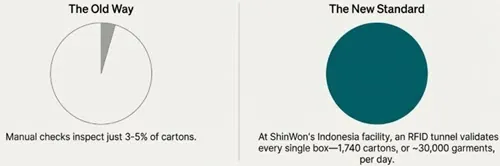
Traditional manual checks inspect 3 to 5 percent of cartons. At ShinWon’s Indonesia facility, the tunnel system validates every single box, 1,740 cartons per day or approximately 30,000 garments [1]. This only works if the RFID tag sewn into each garment survives the full production cycle. That includes dyeing at 95 degrees Celsius, industrial washing for 50 or more cycles per ISO 6330, and final pressing at 180 degrees Celsius. Without tag reliability, 100 percent verification is theater. In our field deployments, we have seen tags fail at the 15th wash cycle. This causes false “missing item” alerts in portals. That is why solutions like our RFID laundry tags, certified to ISO 6330 for 200 plus industrial washes, are not a premium feature. They are the baseline for data integrity.
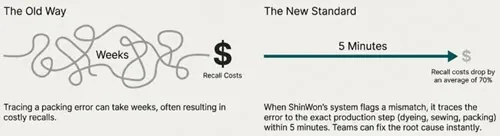
When ShinWon’s system flags a data mismatch, for instance a tag ID that does not match the carton manifest, it traces the error to the exact production step, whether dyeing, sewing, or packing, within 5 minutes [3]. Recall costs drop 70 percent because teams fix root causes, not symptoms. This speed hinges on one thing. The tag’s data must remain readable after repeated handling, folding, and exposure to metal zippers. Flexible, metal-tolerant tags are not optional. They are what keep the data chain intact.
ShinWon’s pilot “farm-to-retail” traceability program links cotton bale IDs to final garment tags. Consumers scan a QR code to see water usage, carbon footprint, and factory certifications [3]. But if the tag fails during washing, the chain breaks and the claim becomes unverifiable.

ShinWon’s rollout signals a broader shift. Walmart’s 2025 supplier guidelines now require 95 percent RFID compliance for knitwear, up from 80 percent in 2024 [4]. Ignoring this is not an option. For brands: Design for RFID early. Reserve a 2 centimeter by 4 centimeter zone in the care label seam. Avoid metal snaps and thick embroidery. Retrofitting adds 8 to 12 cents per unit. For factories: You do not need to build your own tunnel system. Start with a modular tag strategy. We have helped factories deploy in under 7 days using standardized kits like our RFID retail tags. This bundles wash-durable flexible tags, anti-theft hard tags, and metal-tolerant care labels.
ShinWon is not selling RFID. They are selling certainty: zero packing errors, zero recall surprises, zero trust gaps. The tiny tag sewn into each garment is not the star. It is the silent witness that makes the whole system credible. When transparency becomes mandatory, reliability is not a spec sheet item. It is your license to operate.