Sally White

RFID Card Material Guide decisions start with one question: will the card body support the chip, antenna, print finish, and reader environment for the full service life? Material choice affects cost, feel, printing, recycling claims, and read reliability.
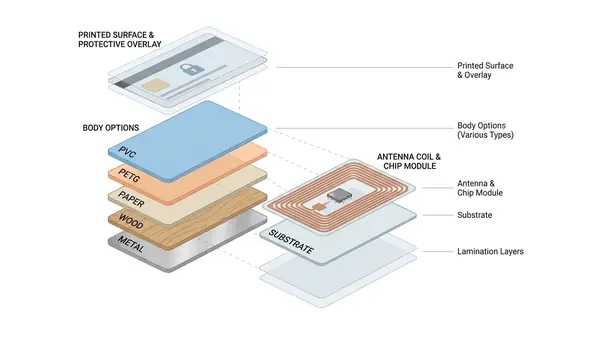
An RFID card is a layered product with a chip, antenna, substrate, card body, printed surface, and protective overlay. The chip stores identity data. The antenna collects energy from the reader and sends data back. The body protects those parts and gives the card its final feel.
Atlas RFID Store describes an RFID system as a reader, tag, and antenna working together. Checkpoint Systems and RFID4U describe the inlay as a chip plus antenna on a substrate. In cards, that inlay sits inside the final body.
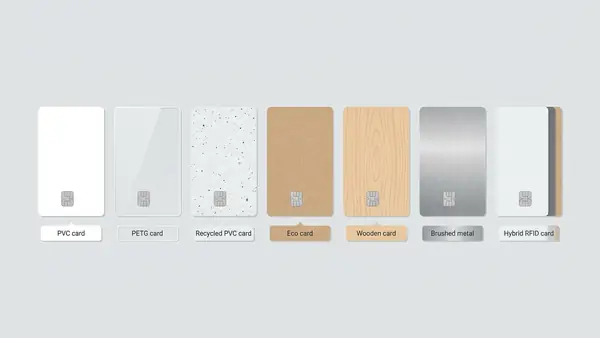
Material affects service life, printing, and RF behavior. PVC is common for short-to-medium-life cards, while PETG, PC, ABS, and protected constructions suit longer use. Smooth plastic supports offset, screen, UV, metallic, frosted, and foil effects better than many natural surfaces. A normal plastic body is RF friendly, but metal, conductive foil, shielding layers, water, or thick decorative structures can weaken reads.
PVC remains the baseline for many custom RFID cards because it is low cost, printable, flexible, and well matched to standard lamination. BioPolyLab says PVC works with printing, lamination, and inlay embedding. Its main weakness is sustainability because multilayer cards with electronics are hard to recycle.
PET and PETG are common upgrades for stronger heat and chemical resistance. SZI says PVC cards often last 2 to 3 years under normal conditions, PETG can reach 3 to 5 years, and PC can reach 5 to 10 years. That makes PETG RFID cards a fit for longer service life.
ABS offers impact and wear resistance. PC fits heat, cold, or personalization needs. These materials cost more than basic PVC, so they should be tied to a real service condition.
Paper and plastic-free cards fit events, short-term passes, and eco-focused programs where long outdoor service is not required. Bio-based and recycled options sit between standard plastic and natural materials. Recycled PVC RFID cards keep many PVC benefits while reducing virgin plastic use.
RFIDCard’s eco material source lists BioPoly Vinyl, BioPoly Stone, and wood. It describes BioPoly Stone as mainly calcium carbonate, waterproof, oil-resistant, and BPA-free. Buyers should still ask for material data and print tests before bulk production.
Wood cards, including bamboo, maple, cherry, black walnut, and basswood, are chosen for natural texture and a premium feel. They suit NFC business cards, gift cards, and eco-themed membership cards. Metal cards create luxury feel and can be waterproof and corrosion resistant, but they need special RFID design because metal can detune or block antennas.
Hybrid designs combine materials, such as a metal face with a non-metal RF window or plastic core. Hybrid RFID cards are often safer when premium feel and reliable tap performance both matter.
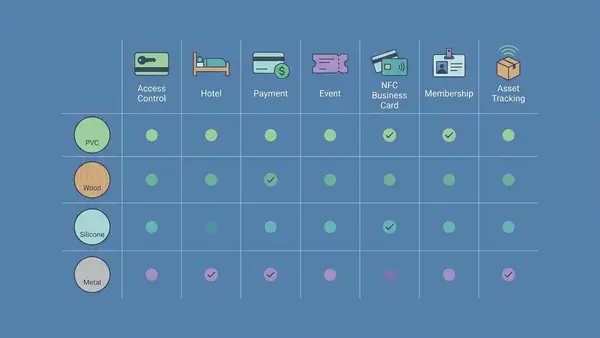
Access control cards start with system compatibility. RFIDCard and Groove Badges describe 125 kHz proximity cards as low-cost and widely compatible, while 13.56 MHz smart cards support encryption and more functions. For simple access, PVC is often enough. For longer use, PETG or ABS can work.
Hotel keys are cost-sensitive and replaced often, but they still need reliable HF performance and clean print. MIFARE Classic, Ultralight C, and DESFire appear often in hotel and access projects. Hotel key cards can use PVC for economy programs, recycled PVC or paper for sustainability, and PETG when service life matters.
Membership cards can carry more brand value. PVC works for large clubs. Wood, metal, BioPoly Stone, or hybrid cards fit premium programs where hand feel matters as much as cost.
NFC business cards usually use 13.56 MHz chips such as NTAG, MIFARE, or compatible families. The body should match the brand: PVC for simple printed cards, PLA or recycled PVC for eco positioning, wood for natural feel, and metal or hybrid cards for premium networking.
Event badges often need fast issue, readable print, low cost, and short service life. Paper, PVC, or thin plastic-free cards can work. For sponsor or VIP cards, wood or metal may be a keepsake, but sampling is needed.
Transit and payment cards are engineering-driven because speed, security, and system approval matter. HF 13.56 MHz cards are common for these uses. UHF cards serve longer-range identification, logistics, and some event workflows. Atlas RFID Store lists UHF cards in CR80 format at 0.762 mm, with some read ranges up to 12 m.
Harsh-use cards should avoid weak paper bodies unless service is short. PETG, PC, ABS, clamshell constructions, or protected specialty cards are better candidates.
Frequency shapes antenna design and material risk. Lowry Solutions states that LF systems use 30 to 300 kHz and read up to about 10 cm. HF systems cover 3 to 30 MHz, often 13.56 MHz, with about 10 cm to 1 m reading distance. UHF systems can reach up to 12 m but are more sensitive to metal, liquids, and electromagnetic noise.
ENCStore describes UHF antennas as dipole-based or meandered designs made from aluminum or copper on PET, PVC, or paper. Etched antennas can give stable impedance and low RF loss, while printed antenna methods can reduce cost and waste.
Metal can reflect, shield, absorb, and detune RFID signals. Liquids, especially water or salt-rich liquids, can absorb or deflect fields. RFIDLabel says LF is less affected but short range, HF can adapt in some metal cases, and UHF is more sensitive.
A metal RFID card is not a normal PVC card with metal swapped in. It may need antenna tuning, a spacer, a plastic window, or a hybrid body. A University of Glasgow UHF RFID antenna study reported a platform-tolerant antenna with 14.7 m free-space range, 14 m on metal plate, and 13 m on wood and glass. That result shows tuned design, not what any ordinary metal card will do.
Manufacturing choices also affect reliability. Lamination temperature, card thickness, overlay, hole punching, metallic inks, foil, laser engraving, and signature panels can all affect the inlay. Newbega lists common card thicknesses around 0.76 mm and 0.86 mm, with thin cards down to 0.188 mm and thick options up to 1.8 mm.
Encoding must be part of the order, not an afterthought. Atlas RFID Store warns that UHF tags may arrive with repeated EPC values or non-guaranteed random values. Buyers should define EPC, UID, user memory, printed serials, QR codes, barcodes, and data reports before production.

Before samples, define the card’s job. Is it for access, hotel use, payment, transit, membership, NFC networking, events, or asset ID? What reader system will it meet? What frequency and chip family are required? Will it sit near metal?
Also decide what matters most: lowest unit cost, print quality, premium feel, greener material, security, or read range. If goals conflict, such as metal feel and long UHF distance, test samples before bulk production.
A clear RFQ should list application, frequency, chip, standard, memory needs, material, dimensions, thickness, finish, artwork, print method, overlay, encoding, packaging, quantity, and sample testing. For UHF, Xerafy says passive chips compliant with EPCglobal Gen2v2 and ISO 18000-63 operate in the 860 to 960 MHz band. For HF, specify 13.56 MHz and the chip family. For LF, specify 125 kHz and access format.
Ask whether printed numbers, QR codes, or barcodes must match encoded data. If the card uses metal, foil, wood, stone, or unusual thickness, require real reader testing with your reader model.
PVC is the most common baseline because it is affordable, printable, flexible, and well matched to standard RFID card lamination.
Yes. Paper can suit short-term or eco-focused cards. Wood can suit NFC business cards, membership cards, and gift cards, but both should be tested for print finish and reader performance.
They can work reliably when the antenna and card body are designed for metal. Ordinary metal layers can block or detune RFID signals, so sampling is required.
No. RFID card material is chosen to let the card communicate with a reader. RFID blocking material is chosen to stop or weaken unwanted reads.