Sophia

RFID and NFC technologies are widely used in access control, payments, asset tracking, logistics, and industrial automation. Behind every RFID card, tag, or label is a communication standard that defines how data is transmitted, secured, and interpreted across systems.
This page provides a practical overview of the most important RFID and NFC standards, explains how they relate to each other, and helps you understand which protocol is best suited for different applications. For deeper technical details, each section links to dedicated articles that explore individual standards in depth.
RFID and NFC standards define how a reader and a tag or card communicate. These standards are developed by international organizations such as ISO and IEC, as well as industry bodies like EPCglobal.
A standard typically specifies:
Standards exist to ensure interoperability. A reader built to a specific standard should work reliably with compliant cards or tags, regardless of manufacturer.
RFID standards are closely tied to operating frequency. The most common frequency bands are:
Each frequency band offers different trade-offs in reading distance, data rate, resistance to interference, and suitability for specific environments. Understanding frequency is often the first step in selecting the right RFID standard.
For a detailed comparison of LF, HF, and UHF RFID, see: RFID Frequency Comparison: LF vs HF vs UHF
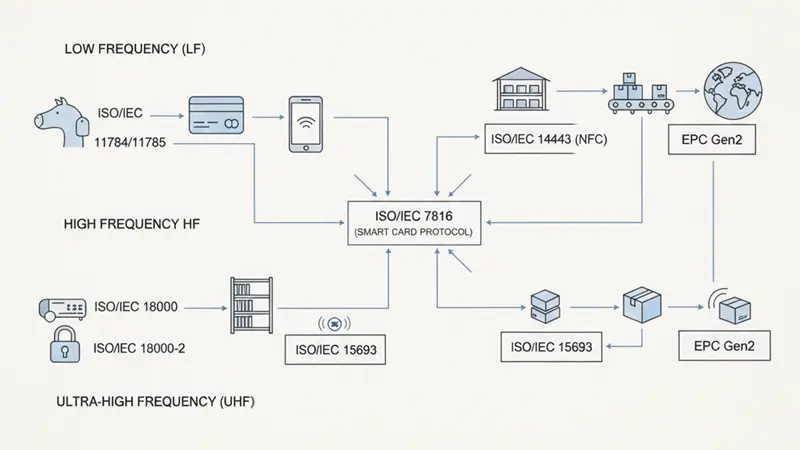
Below is a high-level overview of the most widely used RFID and smart card standards, grouped by their typical use cases.
ISO/IEC 7816 defines contact-based smart cards, where the card must physically touch a reader through metallic contacts. This standard is commonly used in:
Although ISO/IEC 7816 is not contactless, it plays a foundational role in smart card technology and security models. Many contactless standards reuse concepts originally defined in ISO/IEC 7816.
Read the full breakdown here: ISO/IEC 7816 Smart Card Standard: Structure, Protocols, and Real-World Use
ISO/IEC 14443 is the core standard behind NFC and proximity cards. It is designed for short-range communication, typically up to 10 cm.
Common applications include:
The short reading distance is not a limitation but a design choice that improves user experience and security. ISO/IEC 14443 is divided into Type A and Type B, which differ in modulation and anti-collision behavior.
To understand how ISO/IEC 14443 compares with other HF standards, see: ISO/IEC 14443 vs ISO/IEC 15693: What’s the Difference?
For a deeper look at security implications, see: The 10 cm Firewall: ISO/IEC 14443 Security Analysis
ISO/IEC 15693 is designed for vicinity cards and tags operating at HF frequency, with a typical reading range of up to 1 meter.
This standard is widely used in:
Compared to NFC, ISO/IEC 15693 prioritizes range and robustness over speed and user interaction.
A detailed explanation is available here: ISO/IEC 15693 Protocol: The 1-Meter Advantage for Industrial Asset Tracking
ISO/IEC 18000 is not a single protocol but a family of standards covering different frequency bands and use cases. Each part of ISO/IEC 18000 defines the air interface for a specific RFID system.
Examples include:
Understanding the ISO/IEC 18000 series is essential for anyone working with industrial and supply chain RFID systems.
Learn more about the structure of this standard family here: ISO/IEC 18000 Series: RFID Air Interface Standards
EPC Gen2, formally standardized as ISO/IEC 18000-63, is the dominant protocol for UHF RFID systems. It is optimized for:
EPC Gen2 enables item-level visibility and is a cornerstone of modern RFID-enabled logistics.For an in-depth technical and market analysis, see: Decoding EPC Gen2 v2: The Protocol for High-Speed Secure UHF RFID
Choosing the right RFID standard depends on several factors:
For example:
A clear understanding of standards helps reduce deployment risks and ensures long-term interoperability.
NFC is often used as a general term, but technically it refers to a subset of RFID technologies based on ISO/IEC 14443.
In simple terms:
Recognizing this distinction helps avoid confusion when comparing products and solutions. Here is the article about RFID vs. NFC vs. Bluetooth
Many of the standards discussed above are implemented in everyday RFID products, including contactless cards, RFID industrial tags, and UHF tags. Understanding the underlying protocol makes it easier to select the right product for your application.
You can explore practical implementations in our RFID Contactless Cards, where different standards are applied across real-world use cases.