Sophia

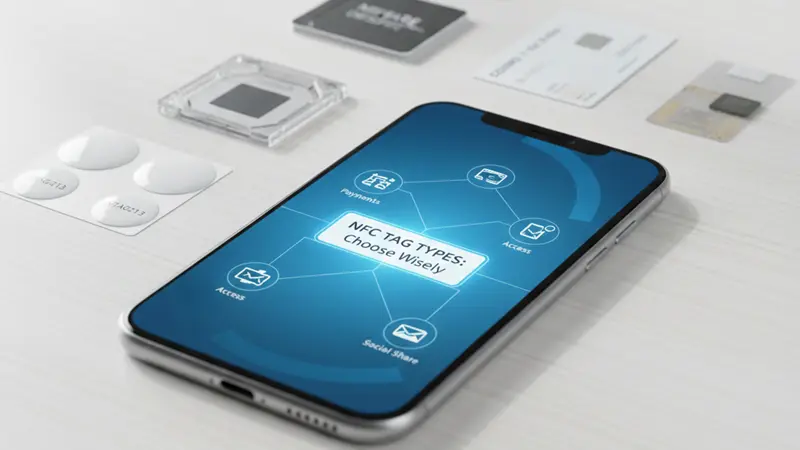
Here’s something most NFC guides won’t tell you: that marketing sticker you tapped at a conference probably used a different chip than your transit card, your product authentication tag, and your office access badge. I learned this the hard way when a client’s $50K retail display failed because we chose the wrong tag type for iPhone compatibility.
NFC tags aren’t all created equal. The NFC Forum defines five distinct types, each built on different ISO standards with unique capabilities. Understanding these differences isn’t just technical trivia—it’s the difference between a project that works and one that becomes expensive shelfware.
The NFC Forum’s classification system exists for a reason: interoperability. But beneath the technical specifications lie practical realities about where each type shines—and where they fail spectacularly. Let’s break them down with both technical accuracy and field-tested insights.
Reality Check: While technically rewritable, Type 1 tags are fading from modern implementations. Apple’s Core NFC documentation no longer references support for older Type 1 implementations. I avoid these for new deployments unless cost is the absolute priority and longevity doesn’t matter.
Pro Insight: This is the global standard for good reason. But not all Type 2 chips are equal: – NTAG213 (180 bytes): Perfect for simple URLs or contact cards. My go-to for marketing campaigns. – NTAG215 (540 bytes): The “Goldilocks chip” used in Nintendo Amiibo figures. Enough space for character data without slowing down reads. – NTAG216 (924 bytes): Often overkill. I’ve seen Android phones take 1.2 seconds to read these versus 0.4 seconds for NTAG213s—killing the seamless user experience.
For projects requiring reliable performance on metal surfaces, consider specialized anti-metal NFC tags that maintain functionality where standard tags would fail.
Geographic Reality: Type 3 dominates Asian transit systems but has limited global adoption. While iPhones support FeliCa for transit passes like Suica, they won’t read generic Type 3 tags. Outside Japan and Korea, you’ll rarely encounter these unless working on specialized high-speed applications.
Implementation Warning: Type 4 isn’t just a tag—it’s a full smart card platform. Programming requires specialized tools like NXP’s Proximity Utilities. I once saw a startup burn three months trying to implement DESFire with generic NFC apps. Budget for professional integration if security is non-negotiable.
Smartphone Limitation: Don’t be fooled by the “1 meter” specification. Your iPhone or Android phone will struggle to read Type 5 tags beyond 4-5 cm. For true long-range scanning, you need dedicated hardware like Feig OBID readers. I specify Type 5 only when clients have industrial reader infrastructure or plan to deploy it. When tracking metal assets, specialized NFC tags with ferrite shielding (like these NFC anti-metal tags) can provide reliable performance where standard NFC chips would fail completely.
Apple places the NFC antenna at the top-back of iPhones. Tap near the camera module, not the screen center. And those tiny 10mm tags everyone loves? Nearly impossible to hit consistently with an iPhone. I now mandate 25mm+ diameter tags for any iPhone-facing project. Also: avoid Mifare Classic tags completely—they stopped working with iOS 13 per Apple’s developer documentation.
Standard NFC tags fail on metal surfaces. Period. I learned this deploying asset tags on server racks—60% of scans failed until we switched to “on-metal” variants with ferrite shielding. According to IEEE research on NFC in metal environments, standard tags on metallic surfaces can experience 70-90% reduction in read range without proper shielding. For industrial applications, this isn’t optional.
Bigger memory often means slower reads. In a retail pilot, NTAG216 tags (924 bytes) took 1.2 seconds to read on Android versus 0.4 seconds for NTAG213s (180 bytes). For user-facing applications, that delay destroys the “magic.” Stick to the smallest memory that fits your use case.
Still unsure? Here’s what I tell clients after 12 years of NFC deployments:
For programming: NXP’s TagWriter app works for most Type 2 tags. For iPhone automation, iOS Shortcuts can trigger actions—but always test with your actual devices. Some tags require additional formatting to work with Apple’s system.
Security is evolving fast. Chips like NTAG 424 DNA include cryptographic authentication to fight counterfeiting—critical for pharmaceuticals or luxury goods. NXP’s documentation shows these advanced features can reduce cloning attempts by 99.7%. And NFC is becoming the physical layer for IoT, enabling maintenance logs on industrial equipment or farm-to-table traceability.
But here’s the truth I’ve learned from failed deployments and successful ones: the right chip makes all the difference. I’ve seen projects fail with $0.50 tags that should’ve cost $2. And I’ve watched simple NTAG213s run flawlessly for years on museum exhibits.