Sophia

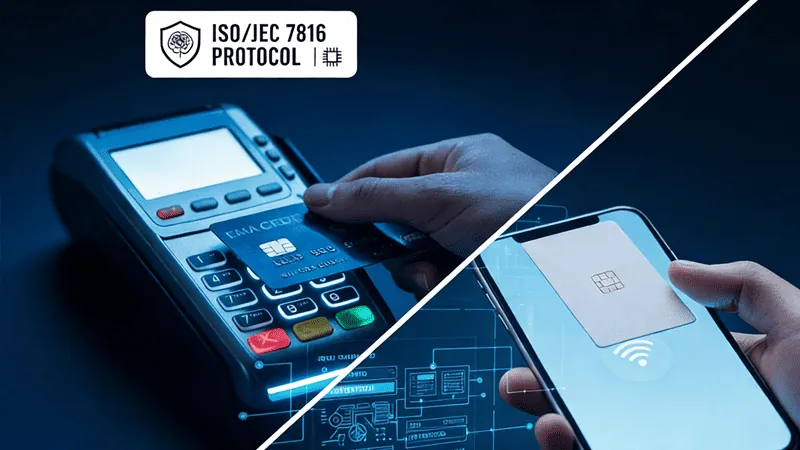
While much of today’s discussion focuses on contactless technologies such as NFC, contact smart cards remain essential in many regulated and security-sensitive industries. Banking, telecommunications, government identification, and secure authentication systems still rely heavily on ISO/IEC 7816–based contact cards [1].
ISO/IEC 7816 is part of a broader ecosystem of RFID and smart card standards. For a complete overview, see our RFID and NFC standards guide.
ISO/IEC 7816 is more than a technical document for engineers. It is a commercial and operational standard that directly affects interoperability, certification, system longevity, and supplier risk. A clear understanding of this standard helps organizations avoid integration issues, re-certification costs, and vendor lock-in.
This article explains ISO/IEC 7816 from a market and procurement perspective, focusing on what business decision-makers and solution owners need to know.
ISO/IEC 7816 is a family of international standards that defines how contact smart cards are designed and how they communicate with card readers [1].

If your system uses a card that must be inserted into a reader, ISO/IEC 7816 is almost certainly part of the solution.
The commercial value of ISO/IEC 7816 lies in cross-vendor compatibility. Cards, readers, operating systems, and applications from different suppliers can interoperate within a stable, standardized framework [2].
ISO/IEC 7816 is divided into multiple parts, each covering a specific aspect of contact smart card behavior [1]. Most projects do not require full coverage of every part.

For most buyers, confirming ISO/IEC 7816-4 compliance is significantly more important than understanding every technical detail.
Procurement discussions often mix contact and contactless technologies, even though they serve different operational goals.
| Factor | ISO/IEC 7816 (Contact) | ISO/IEC 14443 (Contactless) |
|---|---|---|
| Interface | Physical contact | Radio frequency (NFC) |
| Typical Use | Banking, SIM, secure ID | Transit, mobile payments |
| Security Control | Highly controlled | Convenience-oriented |
| Deployment Lifecycle | Long-term | Faster refresh |
Organizations that also deploy contactless solutions often use both standards in parallel [5]. For readers interested in the contactless side of smart cards, you can explore our RFID Contactless Cards for an overview of available technologies.
When a contact smart card is inserted into a reader, communication follows a standardized and predictable sequence [6]:
The reader supplies power to the card
The card sends an initial response describing its capabilities
A communication protocol is established
Applications exchange commands and responses
This deterministic behavior is one reason ISO/IEC 7816 is trusted in regulated environments where reliability and auditability matter.
APDU (Application Protocol Data Unit) commands are the core mechanism defined in ISO/IEC 7816-4 [3]. They control:
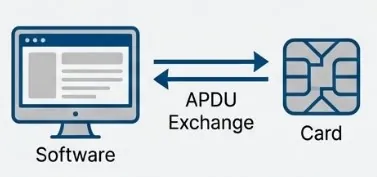
Application selection
File access and data exchange
Authentication and authorization checks
From a purchasing and integration perspective, one of the most important questions is: Does the card fully support the APDU command set required by my application?
A lack of APDU compatibility is a common reason for project delays and unexpected software changes.
ISO/IEC 7816 was designed with security as a foundational principle [4].
In industries such as finance and government, mature standards are often preferred because they reduce certification risk and simplify compliance audits [7].
Based on real-world deployments, the following issues appear frequently:
These problems often surface late in the project lifecycle, when changes are costly.
Despite the growth of contactless solutions, ISO/IEC 7816 remains essential in:
In many of these sectors, replacing contact-based systems is constrained by regulation, infrastructure investment, and certification cycles.
When assessing cards or solutions, decision-makers should verify:
Suppliers who can clearly explain their implementation approach typically have deeper standards expertise.
ISO/IEC 7816 is not simply a legacy technical standard. It remains a strategic foundation for secure, long-term smart card deployments. For organizations operating in regulated or high-risk environments, choosing ISO/IEC 7816-compliant solutions is a business decision focused on stability, security, and interoperability.
Understanding the standard enables better procurement decisions and reduces long-term operational risk.