Sophia

The correct designation is ISO/IEC 18000, a series of international standards jointly published by the International Organization for Standardization (ISO) and the International Electrotechnical Commission (IEC). These standards fall under Joint Technical Committee 1, Subcommittee 31 (JTC 1/SC 31), which oversees automatic identification and data capture technologies.
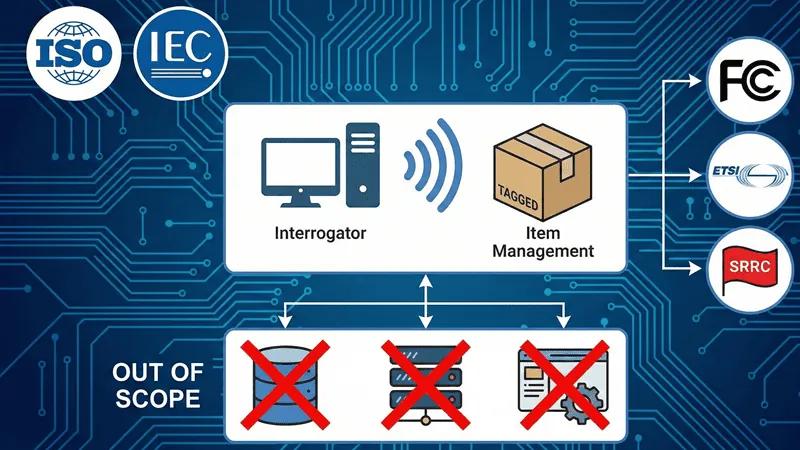
“This part of ISO/IEC 18000 specifies the parameters for air interface communications for RFID devices… intended for item management.”
ISO/IEC 18000-1:2023, Clause 1
That is the complete scope. The series defines only the physical and protocol-layer interaction between interrogator and tag. It does not address data semantics, middleware interfaces, or application logic. This is not guidance. It is a technical contract. If any clause is violated, the device will fail formal conformance testing. Regulators worldwide, including the FCC, ETSI, and China’s SRRC, use these standards as the basis for equipment certification. Our task is to examine what the contract actually says — and where its jurisdiction ends.
ISO/IEC 18000 operates as a modular system:
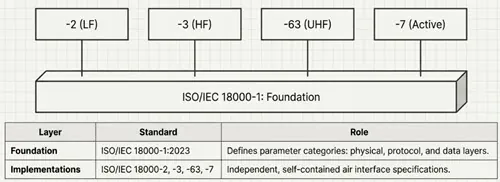
Critically, the standard states:
“Each part of ISO/IEC 18000 is intended to be used independently.”
ISO/IEC 18000-1:2023, Clause 4
A UHF system may be built using ISO/IEC 18000-63 alone. Knowledge of other parts is neither required nor permitted in the implementation.
The 134.2 kHz band is mandated for animal identification by the World Organisation for Animal Health (OIE). Devices operating outside this frequency will not be accepted at international livestock checkpoints.
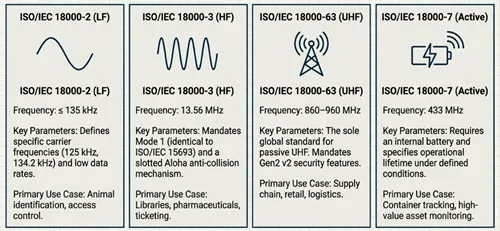
The 2020 edition retains only Mode 1:
“This part specifies the parameters for air interface communications at 13.56 MHz for Mode 1 only.”
Mode 1 is technically identical to ISO/IEC 15693:2023. In practice, engineers reference 15693 for application-level commands, but conformance testing is performed against 18000-3.
Binary tree-walking is not permitted under this standard.
This is the current and only valid UHF air interface standard. It supersedes all prior versions of ISO/IEC 18000-6.
Local regulations impose subsets:
– United States (FCC): 902–928 MHz
– European Union (ETSI): 865–868 MHz
– China (GB/T 29768-2023): 840–845 MHz and 920–925 MHz
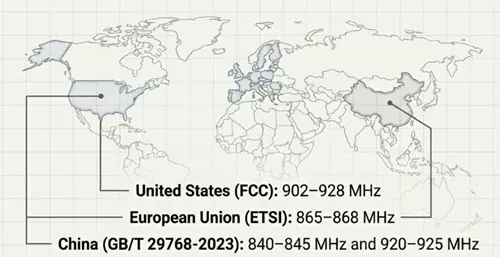
A reader certified for ETSI operation cannot legally transmit in the 865–868 MHz band within the United States, even if hardware supports it.
The “defined duty cycle” assumes transmissions of less than 1 millisecond every 5 seconds. Higher activity invalidates the 3-year claim.
Many deployment failures stem from assuming the standard governs domains it explicitly excludes.
| Domain | Covered? | Governing Document |
|---|---|---|
| EPC data formats (SGTIN, GRAI) | No | EPCglobal Tag Data Standard |
| Reader-to-middleware communication | No | EPCglobal LLRP or ISO/IEC 24791-2 |
| Cryptographic key management | No | ISO/IEC 29167 series |
| Conformance test procedures | No | ISO/IEC 29176 series |
The standard is clear:
“This part does not specify data content, data syntax, or application protocols.”
ISO/IEC 18000-1:2023, Clause 1
It ensures communication can occur. It does not ensure the exchanged data is meaningful to downstream systems.
Formal conformance and real-world reliability are not the same.
Physical-layer variability
While ISO/IEC 18000-63 permits Miller-4 encoding, it sets a minimum sensitivity of –14 dBm. Many low-cost tags exhibit error floors below –18 dBm. In metal-dense environments, effective read range may drop by more than 60 percent.
Protocol implementation differences
The standard requires adaptive Q adjustment but does not prescribe response thresholds. One vendor increases Q after a single collision; another waits for three. Mixed-reader installations often show 10–20 percent lower inventory accuracy than single-vendor deployments.
Regional divergence in China
GB/T 29768-2023, China’s national adoption of ISO/IEC 18000-63, adds mandatory requirements:
“The TID memory shall include a 2-byte Manufacturer Code assigned by MIIT.”
Clause 8.2.1, GB/T 29768-2023
However, no public registry of these codes exists. Collisions in the TID space have caused customs rejections at major ports. Moreover, while the global standard allows up to 4 W EIRP in certain regions, GB/T 29768 limits effective radiated power to 0.5 W indoors. An FCC-certified portal may achieve 12 meters of range in Texas but only 4 meters in a Shanghai distribution center.
In summary, conformance secures regulatory approval. Operational robustness requires additional validation under real-world conditions.
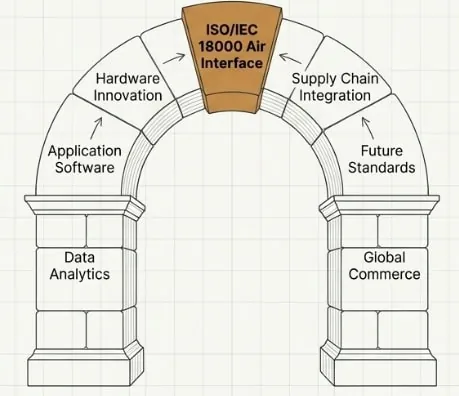
ISO/IEC 18000 succeeds not through technological ambition, but through disciplined constraint. It codifies agreements on microsecond-level timing, modulation depth, and collision definitions — enabling interoperability across continents and supply chains. Future developments, such as ISO/IEC 18000-64 for ultra-low-cost tags or enhanced security in ISO/IEC 29167-10, will extend this framework. But the core principle remains unchanged: Define the interface, verify the implementation, and leave application innovation to the market.
Because in global commerce, the most valuable signal is not the strongest one — it is the one that is universally understood.
The ISO/IEC 18000 series is part of a larger family of RFID air interface standards. A complete overview of these standards is available in our RFID and NFC standards guide .