Sophia


When a maintenance technician scans a tool cabinet in a steel mill, or a librarian clears a bookshelf in 10 seconds, they rely on a protocol most consumers have never heard of: ISO/IEC 15693. This is not NFC. It is not UHF. It is a precisely engineered physics contract for magnetic coupling at 1 to 1.5 meters. As factories digitize and supply chains demand real-time visibility, understanding this standard’s raw capabilities—and limits—is critical for engineers building robust asset tracking systems.

ISO/IEC 15693:2023 is the fourth edition of the standard, published on November 24, 2023. It supersedes the 2018 version and is maintained by ISO/IEC JTC 1/SC 17/WG 8 [1]. Its scope is technical, not commercial:
“The operating distance shall be up to 1.5 m.”
Clause 5.2, ISO/IEC 15693-2:2023
This is not a suggestion. It is a measurable boundary defined by magnetic field strength (0.15 to 5 A/m), antenna geometry, and tag sensitivity. Exceed it, and the system fails conformance testing.
ISO/IEC 15693 is one of several RFID standards optimized for industrial environments. For an overview of how it fits within the RFID protocol landscape, see our RFID standards overview.
ISO/IEC 15693 is structured in three parts. Each solves a distinct layer of the problem.
| Part | Responsibility | Key Constraint |
|---|---|---|
| 1 | Physical characteristics | ISO/IEC 10373-6 compliance for environmental stress |
| 2 | RF power and signal interface | ASK modulation with Manchester encoding (PPM removed in 2023) |
| 3 | Anticollision and protocol | Dynamic Framed Slotted ALOHA (DFSA) mandatory |
The 1.5 m range stems from physics. At 13.56 MHz, communication uses magnetic near-field coupling. Signal strength decays with the cube of distance (∝ 1/d³). To reach 1.5 m, the standard mandates lower field strength than ISO/IEC 14443:
“The magnetic field strength at the tag position shall be between 0.15 A/m and 5 A/m.”
Clause 6.1, ISO/IEC 15693-2:2023
For comparison, ISO/IEC 14443 requires 1.5 to 7.5 A/m for its 10 cm range [2]. Lower field strength enables longer range but demands more sensitive tag design.
Theoretical data rates (26.48 or 53.06 kbps) matter less than real-world throughput. Auburn University’s RFID Lab tested 12 compliant reader-tag combinations under controlled conditions:
Results: average identification speed of 52 to 68 tags per second [3]. This is the number that matters for system design—not the raw kbps.
Confusing ISO/IEC 15693 with other protocols creates costly deployment errors. The standard’s value is context-specific.
| Scenario | 15693 Advantage | When to Choose UHF |
|---|---|---|
| Metal parts tracking | Stable 0.8–1.2 m read distance (magnetic coupling unaffected) | Avoid UHF; signals reflect unpredictably off steel |
| Library inventory | 1 m shelf scanning without line-of-sight | UHF requires precise antenna aiming per book |
| High-density tool crib | 60+ tags/s throughput in confined space | UHF suffers multipath interference in metal cabinets |
A 2024 NIST study confirmed this: in environments with >30% metal content, ISO/IEC 15693 systems maintained 92% read accuracy, while UHF dropped to 47% [4].
Since 2017, NFC Forum Type 5 has included ISO/IEC 15693 [5]. But implementation is fragmented:
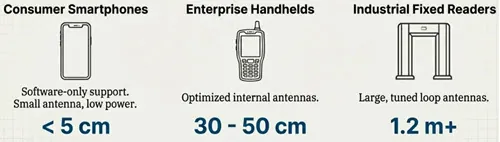
The rule is simple: If your use case requires >10 cm, budget for industrial hardware. Consumer devices will disappoint.
Never deploy ISO/IEC 15693 for payment. Its lack of mandatory AES and 1.5 m range invite attacks. To fully understand the differences in protocol security and why the 10cm firewall is non-negotiable for transactions, review our comparative analysis on ISO/IEC 14443: The Standard for High-Security Proximity Payments.
For engineers, the lesson is physical: Respect the 1.5 m limit. Optimize for DFSA throughput, not kbps. And never assume NFC compatibility means performance parity. The standard’s value is not in its name, but in its measurable, repeatable output.
The choice between ISO/IEC 14443 and 15693 is not about technology preference. It is about matching the protocol to the physical interaction model. If your requirements demand the 10 cm firewall for transaction security, such as payment or secure access control, explore our RFID wristbands designed for high-security proximity applications.
Security design choices in ISO/IEC 14443 can only be fully understood in the context of other RFID and NFC standards. Our RFID standards guide explains these relationships in detail.