Sophia

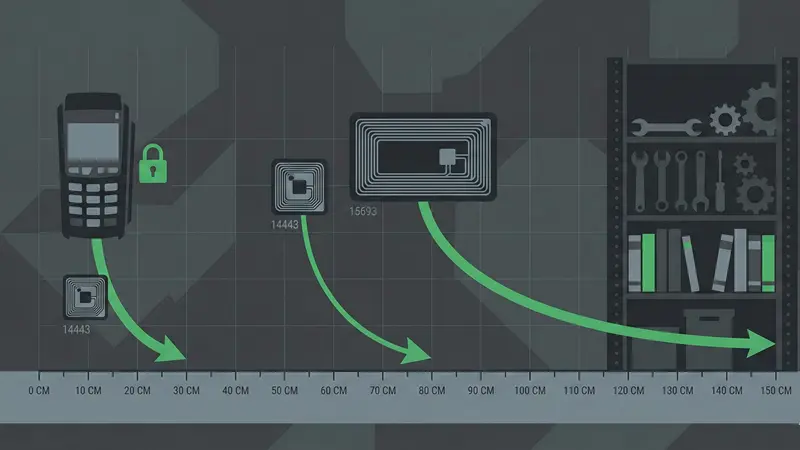
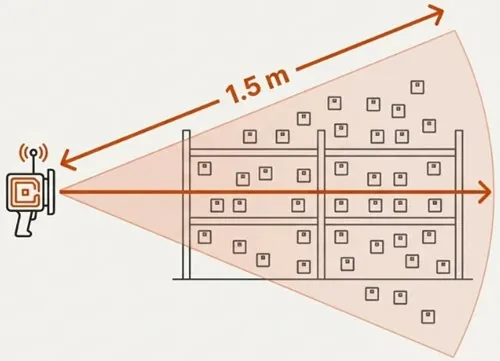
When designing an RFID system for 13.56 MHz, engineers face a fundamental choice: ISO/IEC 14443 or ISO/IEC 15693. This is not a matter of preference. It is a decision dictated by physics, security requirements, and real-world performance. The right rfid tags must be selected to match the protocol’s constraints—whether it’s the 10 cm security firewall of 14443 or the 1.5 m bulk-scanning capability of 15693. Confusing the two leads to costly failures: payment systems that fail certification, or asset trackers that miss half the tags on a shelf.
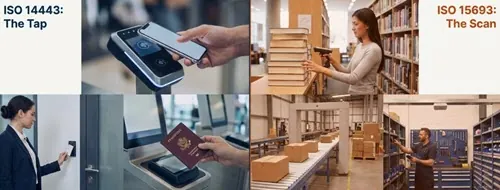
The divide between these protocols is hard-coded in the standards themselves.
“The operating distance shall not exceed 10 cm.”
Clause 5.2, ISO/IEC 14443-2:2023
“The operating distance shall be up to 1.5 m.”
Clause 5.2, ISO/IEC 15693-2:2023
These are not suggestions. They are testable limits enforced during conformance certification. Exceed 10 cm with 14443, and your payment terminal fails EMVCo testing. Operate 15693 below 0.5 m consistently, and you waste its core advantage.
Before diving into technical specs, ask one question: What is the user’s physical interaction?
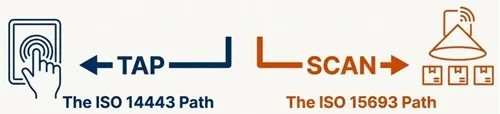
| Your Use Case | Protocol | Why |
|---|---|---|
| User taps a terminal (payment, access) | ISO/IEC 14443:2023 | Mandatory AES-128, transactions complete in <100 ms |
| Scan a shelf or tool crib from 1 meter | ISO/IEC 15693:2023 | 50–70 tags/second throughput, stable in metal environments |
| Read with a standard smartphone | Only 14443 | 15693 requires industrial-grade hardware for full range |
This rule eliminates 90% of selection errors. If your application involves intentional user action (a tap), choose 14443. If it involves passive bulk scanning, choose 15693.
Security is not a feature in 14443. It is the foundation.
“The use of DES is not recommended for new implementations. AES-128 shall be used for mutual authentication.”
Clause 8.2, ISO/IEC 14443-4:2023
This aligns with EMVCo’s Contactless Specifications v3.0, which states: “DES shall not be used” [1]. In contrast, ISO/IEC 15693 has no mandatory encryption. Its data layer is designed for speed, not secrecy.
Data rate (kbps) is a red herring. What matters is tags per second.
Auburn University’s RFID Lab tested both protocols under identical conditions: 50 tags in a 1 m³ volume, reader 1 meter away.
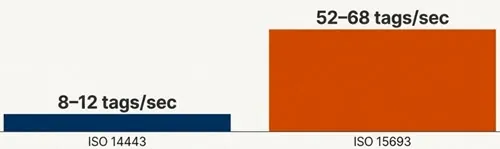
Source: ARC Report #2024-07
Why the gap? 15693’s Dynamic Framed Slotted ALOHA (DFSA) dynamically adjusts frame size to match tag count. 14443’s pure ALOHA is optimized for single-tag speed, not bulk efficiency.
NFC Forum defines two relevant types:
Critical fact: No consumer smartphone achieves >5 cm for Type 5. Qualcomm’s 2023 NFC whitepaper confirms this is due to antenna size and power limits [2].
If your project requires smartphone interaction, 14443 is your only viable option. For industrial asset tracking, budget for dedicated hardware.
ISO/IEC 14443 and 15693 are not competitors. They are specialized tools for distinct jobs.
Never mix them in the same system. A 14443 reader cannot activate a 15693 tag, and vice versa. The RF layers are physically incompatible [3].
Both ISO/IEC 14443 and ISO/IEC 15693 belong to a wider set of RFID standards, each designed for different use cases. A full comparison is available in our RFID standards guide.
The best protocol is not the newest or the fastest. It is the one whose physics matches your use case. Respect the 10 cm firewall. Leverage the 1.5 m advantage. And let the standard, not the sales brochure – guide your decision.