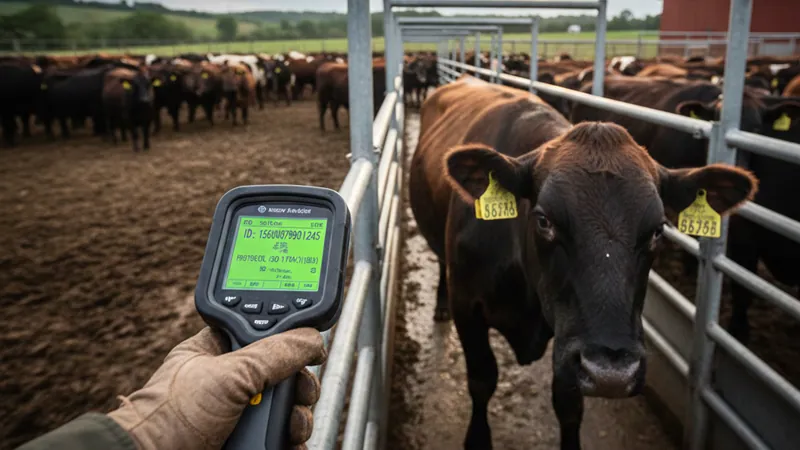
If you’ve ever tried to sort a thousand head of cattle on a wet morning or manage a high-speed automated feeding system, you know that RFID isn’t just a “feature”—it’s the backbone of your ranch’s efficiency. But why do some tags scan instantly while others leave you waving a reader in frustration?
The answer lies in the ISO/IEC 11784/11785 protocols. These aren’t just dry technical specs; they are the “Global Language” of livestock management. From ensuring your 15-digit IDs are unique to picking the right signal for metal-heavy environments, understanding these standards is the difference between a “glitchy” operation and a smooth, automated workflow. Let’s break down how this technology works in the real world of livestock production.
1. The “Dynamic Duo”: ISO 11784 vs. ISO 11785
People often lump these two together, but they play very different roles. It’s best to think of them as the “Letter” and the “Radio.”
- ISO/IEC 11784 (The Language): This defines the coding structure. It dictates exactly how that 15-digit ID is formatted, ensuring the data looks the same regardless of who made the chip.
- ISO 11785 (The Radio): This defines the technical transmission. It’s the physical layer that tells the reader what frequency to use to “call” the chip and how the chip should “shout” back.
2. ISO/IEC 11784: The Secret Inside the 64-Bit Code
While your scanner displays a 15-digit decimal number, the chip internally stores that identity in a 64-bit binary vault. Understanding how these bits translate into the numbers we read is key to mastering the standard.

Decoding the 64-Bit Binary Structure
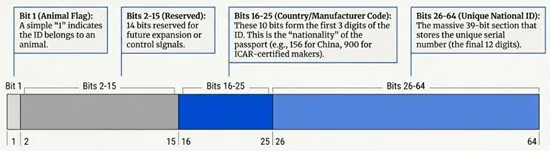
According to the official ISO 11784 specification (Table 1), the 64 bits are partitioned to ensure global uniqueness:
- Bit 1 (Animal Flag): A simple toggle. If it’s “1”, the chip is identifying an animal.
- Bits 2-15 (Reserved/Retransmission): These 14 bits are held for future expansion or specific control signals.
- Bits 16-25 (Country/Manufacturer Code): These 10 bits store the origin. When converted to decimal, they form the first 3 digits of the ID (e.g., 156 for China or 900 for ICAR-certified makers).
- Bits 26-64 (Unique National ID): This massive 39-bit section stores the actual serial number. It translates into the final 12 digits of the decimal ID.
Technically speaking, this combination allows for over 274 billion unique IDs per country code—guaranteeing that no two animals will ever share the same passport.
3. ISO/IEC 11785 Explained: How the Reader “Sees” the Chip
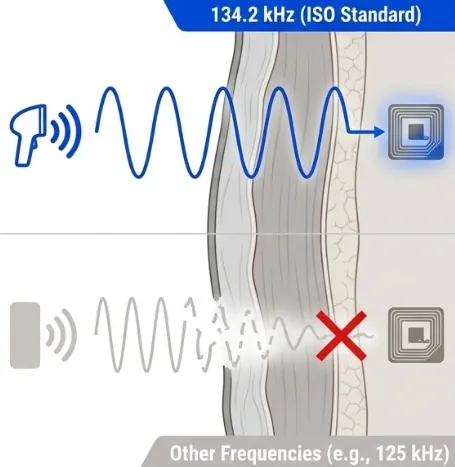
You might wonder why animal identification settled on the seemingly obscure 134.2 kHz frequency instead of the standard 125 kHz used in office keycards. The answer lies in biology. Animal bodies are primarily composed of water, and 134.2 kHz (Low Frequency) is exceptionally good at penetrating muscle, blood, and tissue with minimal signal loss or environmental noise interference.
FDX-B vs. HDX: The Battle in the Sorting Chute
ISO 11785 defines two primary ways for the chip and reader to communicate. While both will eventually display that 15-digit ID, their performance in a rugged ranch environment is night and day:
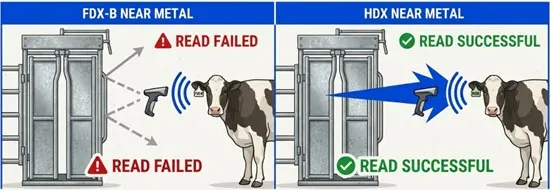
- FDX-B (Full Duplex): The reader and chip talk at the same time. It’s incredibly fast and serves as the global standard for domestic pet microchips and urban dog management. However, it can be sensitive to electronic interference, especially near large metal structures.
- HDX (Half Duplex): Think of this like a high-powered walkie-talkie. HDX provides a stronger signal “burst” during transmission, which offers superior penetration power. For large-scale ranching operations facing interference from metal fences, rainy weather, or automated sorting systems, choosing professional-grade animal RFID tags powered by HDX technology ensures a much smoother workflow and significantly reduces missed reads.
4. Real-World Performance: Surviving the Yard
In a controlled lab environment, RFID technology works perfectly. However, in the field—especially in a bustling feedlot—it’s a different story. Achieving a 100% read rate depends on more than just the protocol; it’s about managing environmental reality:
- Reading Range: For most handheld scanners, you are typically looking at a range of 10cm to 30cm. However, the actual performance often depends on the reader’s power output and the quality of the tag’s internal antenna.
- The Metal Challenge: Metal is the natural enemy of RFID signals. Heavy iron gates, high-power electrical lines, or even a metal squeeze chute can shrink your reading distance or cause signal “blind spots.” If your livestock management feels “clunky” near sorting gates, it is often a sign you need a high-output reader paired with HDX-capable tags.
- Durability & Life Cycle: An ISO-compliant code is useless if the tag falls out or breaks. Professional-grade Animal RFID Tags are engineered to combine ISO 11784/5 logic with UV-resistant, tamper-proof housing. This ensures that the ID stays with the animal from birth all the way to processing, regardless of mud, heat, or physical impact.
5. Staying Compliant: What is ICAR?
You’ll see the ICAR name a lot. They are the global gatekeepers for animal identification. They register manufacturers and ensure chips actually follow the ISO rules.
Pro Tip: You can use ICAR’s public database to verify a chip. Type in the 15-digit ID, and it will tell you if the manufacturer is legit. It’s the best way to spot “black market” chips that might fail at customs.
6. Common Myths & FAQ
- Q: Can a 125kHz reader read ISO 11784 chips?
- No. 11784/5 requires 134.2 kHz. 125 kHz readers lack the necessary protocol support as defined in ISO/IEC 11785:2014, Annex A.
- Q: What does a 900 prefix mean?
- It indicates a manufacturer code (900–999) certified by ICAR. Non-9xx chips that aren’t valid country codes might be rejected in official tracking systems.
- Q: How to verify chip authenticity?
- Use ICAR’s public database. Enter the full 15-digit ID to validate the country or manufacturer. It’s the ultimate BS detector.
- Q: FDX-B vs HDX for cattle?
- For cattle and large-scale ranching, HDX is strongly recommended. Its superior range and ability to perform near metal fences and automated waterers make it much more reliable than FDX-B in a typical farm environment
- Q: Is 11784/5 required for US pet travel?
- Yes for dogs (per 7 CFR § 91.105). Cats also generally require ISO 11784/5 chips for entry into the EU.
Sources:
Ready to dive deeper? My next piece will cover ISO/IEC 7816, the “brain” behind the smart cards in your wallet. It’s the perfect technical companion to this guide.