Sophia


Let’s be honest. Nobody dreams of revolutionizing the gowning room. It’s not the operating room. It’s not imaging. It’s the hallway just before the action, where scrubs get snagged, shoe sizes don’t match, and someone’s always hunting for a clean cap.
Yet quietly, across Europe and parts of Asia, hospitals are turning this unglamorous space into one of their sharpest operational edges. And no, it’s not about flashy robots or AI dashboards. It’s about something simpler and frankly smarter: knowing, at all times, where every gown and every pair of shoes is, and who’s wearing what.
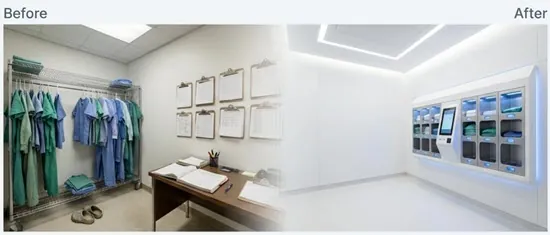
The figures in this article come from a publicly disclosed tender award, a real procurement record for a smart gowning system deployment. All costs and performance outcomes reflect audited, post-implementation data. No estimates. No projections. Just what actually happened.
You might think losing a few gowns is no big deal. But according to Zhang and colleagues in the Journal of Healthcare Engineering (2022) [1], facilities using manual systems often lose up to 15 percent of their reusable surgical textiles each year. That’s not a rounding error. For a hospital managing 8,000 items, that means roughly one in seven goes missing.
And the cost isn’t only financial. The World Health Organization made this clear in its 2021 Guidelines for Safe Surgery [2]: traceability of sterilized textiles is essential for infection prevention. Without it, confirming when a gown was last cleaned, or even who last wore it, often falls to memory and luck. Infection control teams know this tension well. So do procurement officers and surgeons stuck waiting in line at shift change.
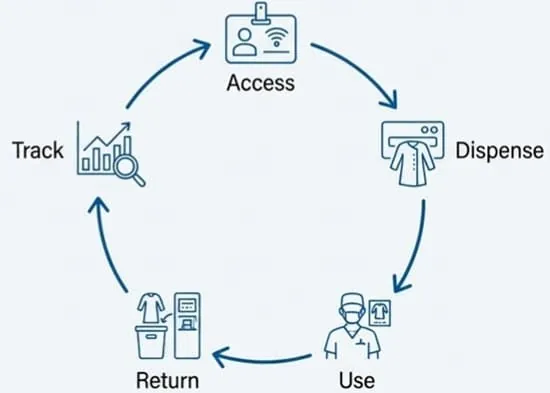
Here’s where it gets practical. At this hospital, the answer was modest but thoughtful: two gowning zones supporting six ORs. The core idea? Intelligent dispensing, secure return, hands-free access, and centralized oversight, all tied together by RFID.
They installed smart dispensers for gowns and shoes, capable of verifying size and real-time inventory. Return stations automatically log who returned what, eliminating guesswork. Foot-activated RFID readers at each entrance let staff enter without touching anything—an upgrade infection control teams quietly applauded.
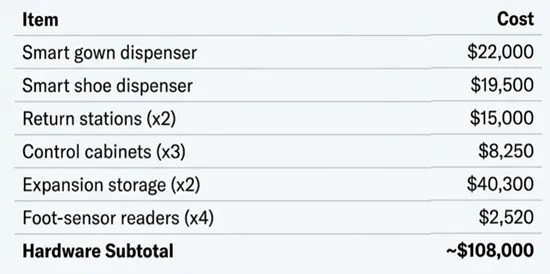
For reference, here’s how the hardware broke down:
| Component | Qty | Est. Cost (USD) |
|---|---|---|
| Smart gown dispenser | 1 | $22,000 |
| Smart shoe dispenser | 1 | $19,500 |
| Return stations | 2 | $15,000 total |
| Control cabinets | 3 | $8,250 |
| Expansion storage | 2 | $40,300 |
| Foot-sensor readers | 4 | $2,520 |
Total: around $108,000. But here’s the thing. The cabinets are just the visible layer. The real workhorse is smaller and sturdier: the RFID tag embedded in every gown and shoe.
Let’s settle this upfront: the RFID tags aren’t optional extras. They’re the backbone. Without them, even the smartest cabinet is just a locked box.
And yes, they add to the total investment. In most public tenders, RFID tags are listed separately from hardware, often under “implementation services” or “consumables.” For a typical deployment of 8,000 gowns and shoes, high-performance, wash-durable RFID Laundry tags run between $0.70 and $1.30 each. That’s roughly $5,600 to $10,400, a modest but essential line item.
These aren’t cheap RFID tags. As textile engineers at the Technical University of Dresden confirmed in their 2024 study (Müller and Schulz) [3], the best ones survive over 200 industrial washes and repeated autoclaving. Each tag gives an item a persistent digital identity. When a surgeon approaches, the system checks their schedule, pulls their preferred size, and releases only items confirmed clean. When they return the gear, the cabinet logs exactly who returned what and when, not as “one gown,” but as “Dr. Lee’s medium, serial G-4872, returned at 3:14 p.m.”
That level of detail may sound granular. But it’s precisely what auditors look for during JCI or ISO 13485 reviews. It turns compliance from a scramble into a click.
The financial impact unfolded quickly. Garment loss dropped from an estimated 13 percent to under half a percent in the first year. At an average replacement cost of $10.60 per item, that alone saved roughly $85,000.
Two staff members were reassigned from inventory duty to direct clinical support, a win for morale and patient care. Laundry cycles became more efficient too. With real usage data, the team stopped washing untouched inventory “just in case.” Their sustainability audit estimated $6,000 in annual savings on water, energy, and detergent.
The Healthcare Financial Management Association captured this well in its 2023 report [4]: automation in non-clinical workflows like textile management often delivers some of the fastest operational wins, primarily by avoiding losses rather than chasing new revenue. In this case, the combined first-year impact exceeded $120,000.
Perhaps the most telling feedback came from the surgeons themselves. Fewer mismatched shoes. No more hunting for clean caps. Entry that felt effortless, not like a checkpoint. And when surveyors arrived unannounced, the team pulled up digital logs in under a minute.
Best of all, the system scales. Adding a new OR? Plug in another cabinet. Launching robotic surgery? Configure new gown protocols in software, not with sticky notes and hope.
So where do smart hospitals begin their digital journey? Often, not in the OR itself, but just outside it. Where the right gown, in the right size, waits for the right person. No drama. No delay. Just work that feels, finally, a little more human.