Sally White

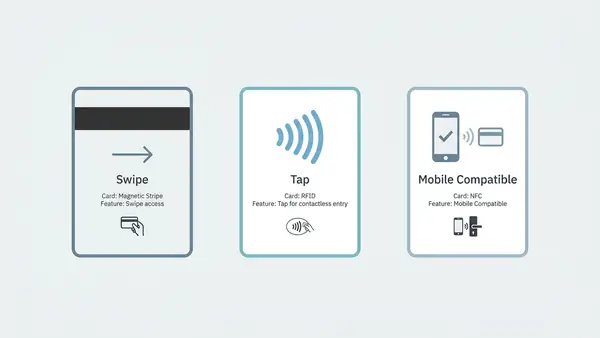
Choosing the right hotel key card for your property affects guest satisfaction, security, and long-term operational costs. This guide breaks down card types, costs, and implementation strategies to help hotel owners and managers make informed decisions.
Hotel key cards have evolved far beyond simple magnetic strips. The technology you choose determines not just how guests access their rooms, but also your property’s security posture and maintenance burden.
Magnetic stripe cards store data on ferromagnetic particles with zero encryption. A $20 reader from Amazon can clone them in under 30 seconds. Despite this glaring vulnerability, they remain popular due to their low upfront cost of $0.08 to $0.25 per card.
RFID cards operate at 13.56 MHz and use silicon microchips instead of magnetic strips. Guests tap rather than swipe, eliminating physical wear. The chip communicates via encrypted challenge-response protocols, making duplication exponentially harder. Standard RFID cards cost $0.25 to $0.50, while advanced AES-128 encrypted versions run $0.80 to $2.00.
NFC cards take RFID further by enabling two-way communication. This allows integration with smartphone-based mobile keys, letting guests use Apple Wallet or Google Pay instead of plastic cards. The technology works identically to contactless payments, with unlock times under 500 milliseconds.
Magnetic cards slide into a reader slot, unlocking when the stripe aligns correctly. Within this category, LoCo (low coercivity) cards cost less but demagnetize easily near phones or wallets. HiCo (high coercivity) cards offer better durability at a modest price increase.
The real cost emerges over time. Hotels report 25-40% annual replacement rates for magnetic cards. A 100-room property replacing 30% of 200 cards yearly spends $48 on card stock alone, but that’s misleading. Add encoding labor ($432), storage management ($648), reader maintenance ($225), and guest service time ($468), and the annual cost hits $2,486, or $24.86 per room.
RFID cards require no physical contact. Guests tap the card near a door sensor, and the encrypted chip authenticates in milliseconds. The embedded chip sits protected inside the card, immune to magnetic fields and physical wear from swiping.
Security varies dramatically by chip generation. Legacy RFID cards using the proprietary Crypto1 cipher were reverse-engineered in 2008 and remain clonable with $200 devices. Mid-range cards use 3DES encryption (168-bit effective key length), offering solid protection for most properties. High-end cards with AES-128 encryption have no publicly known cloning method when properly configured.
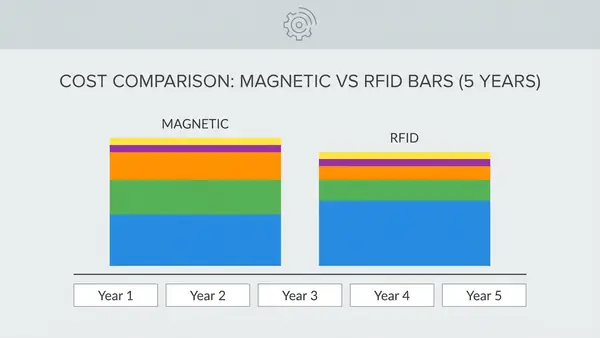
RFID cards cost 2-4 times more upfront than magnetic cards, but lower replacement rates and reduced maintenance narrow the gap. Over five years, total cost of ownership often favors RFID despite higher per-card pricing.
NFC technology enables smartphone-based room access through digital wallets. Guests receive a mobile key via email or app, add it to Apple Wallet or Google Pay, and tap their phone to unlock doors. No app download required, no Bluetooth troubleshooting, no plastic waste.
The guest experience difference is stark. Traditional mobile keys using Bluetooth Low Energy average 5-10 second unlock times and require the app to be running. NFC wallet keys unlock in under 500 milliseconds and work even when the phone battery is dead (thanks to Power Reserve mode on iPhones).
Implementation complexity matters. BLE systems often require middleware to bridge your PMS, lock hardware, and guest app. NFC wallet solutions integrate more cleanly, reducing sync errors and support burden.
Per-card pricing tells only part of the story. Total cost of ownership over five years reveals the true financial impact of your key card decision.
A 100-room hotel buying magnetic cards at $0.10 each spends $20 for initial stock (200 cards). RFID cards at $0.40 each cost $80 for the same quantity. That $60 difference feels significant until you factor in replacement rates.
Magnetic cards demagnetize from phone proximity, wallet pressure, and reader wear. Properties report replacing 25-40% annually. RFID cards last 3-5+ years with minimal failures. Over five years, a magnetic system requires 150-200 replacement cards ($15-20), while RFID needs perhaps 30-40 ($12-16).
The encoding equipment cost also differs. Basic magnetic encoders run $2,000-3,000. RFID encoders cost $3,000-5,000. Amortized over five years, that’s $400-600 annually for magnetic, $600-1,000 for RFID.
Labor costs dwarf card stock expenses. Front desk staff spend 2 hours monthly encoding, testing, and managing inventory. At $18/hour, that’s $432 annually. Storage and organization add another 3 hours monthly ($648/year).
Guest service time compounds the problem. Magnetic cards fail more often, generating late-night reissue requests and front desk complaints. Hotels estimate 30 minutes weekly handling key card issues, costing $468 annually in staff time.
Reader maintenance hits magnetic systems harder. Physical swiping wears out readers faster than contactless tapping. Budget $150-300 annually for reader replacements with magnetic systems, versus $100-150 for RFID.
A comprehensive five-year cost breakdown for a 100-room hotel:
Magnetic System:
– Initial setup: $3,120 (equipment + cards)
– Annual operations: $2,486
– Five-year total: $15,550
RFID System:
– Initial setup: $3,580 (equipment + cards)
– Annual operations: $1,850 (lower replacement, maintenance, service costs)
– Five-year total: $12,830
The RFID system saves $2,720 over five years while delivering better security and guest experience.
Key card security vulnerabilities have exposed millions of hotel rooms to unauthorized access. Understanding encryption standards helps you avoid becoming the next headline.
Magnetic stripe cards store data in plaintext. No encryption, no authentication, no protection. A magnetic stripe reader/writer costs $20-100 on Amazon and clones cards in under 30 seconds. In 2012, researchers demonstrated that 4-5 million hotel rooms could be opened with a $50 Arduino-based device exploiting port vulnerabilities in magnetic locks.
RFID security depends entirely on the chip. Legacy chips using the Crypto1 cipher were publicly broken in 2008 by researchers at Radboud University. Despite being compromised for 17+ years, these chips remain in active use. A Flipper Zero ($170) can read and emulate many older RFID cards.
Mid-range RFID cards use 3DES encryption with 168-bit effective key length. They resist most cryptographic attacks and provide adequate security for the majority of hotels. The slower performance due to multiple encryption rounds rarely impacts guest experience noticeably.
Advanced RFID cards with AES-128 encryption (128, 192, or 256-bit keys) have no publicly known practical cloning method when properly configured. These cards cost more but deliver the highest security level available in hotel key card technology.
Both RFID and magnetic systems allow remote deactivation of lost or stolen cards. Unlike traditional metal keys requiring lock replacement, digital cards can be invalidated instantly from the front desk.
Time-based access restrictions automatically expire cards at checkout. This prevents guests from returning after their stay ends. RFID systems typically offer more granular control, allowing access to specific areas (gym, spa, parking) beyond just room entry.
The real security advantage of RFID lies in its resistance to demagnetization. Magnetic cards fail when exposed to phones, credit cards, or magnetic clasps. Guests locked out of their rooms create security risks when they prop doors open or seek alternative entry methods. RFID cards maintain functionality regardless of what’s in the guest’s pocket.
According to a 2024 Hotel Dive report, security researchers discovered vulnerabilities in Saflok key card systems affecting up to 3 million hotel rooms. The incident underscores that even modern systems require proper implementation and regular firmware updates to maintain security.
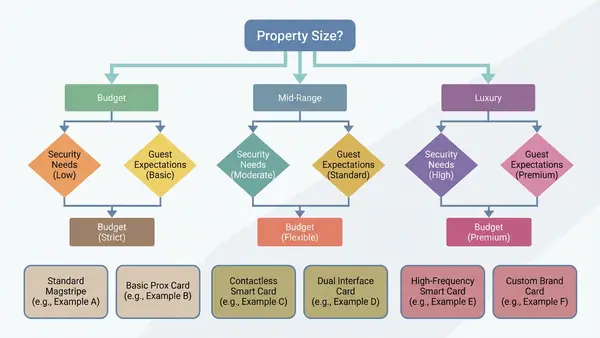
Not every hotel needs the most advanced technology. The right choice depends on your property size, guest demographics, and budget constraints.
Properties with 50 rooms or fewer and tight budgets can justify magnetic stripe cards if they accept the trade-offs. Choose HiCo (high coercivity) magnetic cards over LoCo versions to reduce demagnetization failures. Budget $0.15-0.25 per card for decent quality.
Keep replacement stock on hand. With 25-30% annual replacement rates, a 50-room property should maintain 30-40 spare cards to avoid emergency orders. Order in bulk (500+ cards) to get better pricing.
Train staff on proper encoding procedures. Misalignment during encoding causes many “card doesn’t work” complaints. Create a simple troubleshooting flowchart for front desk staff to diagnose issues quickly.
Consider upgrading to basic RFID if your lock system supports it. The $0.25-0.40 per card cost increase pays for itself through reduced replacement and maintenance over 2-3 years.
Properties with 100-300 rooms serving business travelers should prioritize RFID with 3DES or AES-128 encryption. Business guests expect seamless check-in and reliable room access. Failed key cards damage your reputation more than the cost savings justify.
Standard RFID cards ($0.25-0.50) provide the best balance of cost and performance for most mid-range properties. Upgrade to encrypted RFID ($0.40-0.80) if your brand standards require it or if you’re in a high-security location.
Implement mobile key options through NFC wallet integration. Business travelers already use digital wallets for payments and boarding passes. Adding room keys to that workflow reduces friction and differentiates your property from competitors.
Budget 10-15% of your key card system budget for PMS integration work. Proper integration enables automated check-in, real-time room status updates, and mobile key provisioning. Poor integration creates more problems than it solves.
High-end properties should view key cards as brand touchpoints, not just functional tools. Wooden RFID cards ($0.80-2.50 for bamboo/birch, $2.00-5.00 for premium woods) create memorable first impressions and often become keepsakes guests take home.
The “loss” of wooden cards actually builds brand awareness. Guests display them on desks or use them as bookmarks, keeping your property top-of-mind. Four Seasons and Mandarin Oriental use wooden RFID cards specifically for this reason.
Consider PLA (polylactic acid) cards made from cornstarch or sugarcane if sustainability matters to your brand positioning. They cost $0.25-0.55 per card, similar to standard RFID, while supporting environmental messaging.
Implement full mobile key functionality with NFC wallet integration. Luxury guests expect cutting-edge technology delivered seamlessly. Requiring app downloads or Bluetooth troubleshooting contradicts the premium experience you’re selling.
Key cards offer more branding potential than most hotels realize. The average guest handles their key card 10-15 times per stay, making it one of your most-viewed brand touchpoints.
Single-color printing on white PVC cards costs $0.15-0.30 per card. Full-color CMYK printing with UV coating runs $0.20-0.45. The price difference is minimal, so choose full-color unless your brand aesthetic specifically calls for minimalist design.
Matte or frosted finishes hide scratches better than glossy coatings. This matters for properties that reuse cards across multiple guests. Visible wear damages brand perception, especially for upscale properties.
Custom shapes cost more ($0.50-1.50 premium) but create instant differentiation. A ski resort might use snowflake-shaped cards. A beach property could choose surfboard shapes. The novelty increases the likelihood guests keep cards as souvenirs.
Laser engraving on wooden cards creates elegant, permanent branding that won’t fade or scratch off. The natural grain ensures no two cards look identical, adding to the premium feel.
PVC production emits high greenhouse gases and releases dioxins during manufacturing. According to Greenpeace, PVC is “the single most environmentally damaging of all plastics.” Properties with sustainability commitments should explore alternatives.
Recycled PVC or PET cards cost the same as virgin plastic ($0.20-0.45) while reducing environmental impact. They work identically to standard cards and require no changes to your lock system.
BioPVC cards with biodegradable additives cost $0.25-0.55 and are certified 100% degradable under specific conditions. They maintain the durability of traditional PVC while supporting green certifications and LEED requirements.
Paper-based cards are fully biodegradable but lack durability. They can’t withstand humidity or pressure, making them unsuitable for guests who swim or carry cards in tight pockets. New manufacturing techniques have brought costs close to PVC parity ($0.20-0.45), but the short lifespan (6-12 months) means higher replacement frequency.
Wooden cards from sustainable forests are carbon-neutral or carbon-negative depending on forestry practices. Bamboo grows rapidly and regenerates without replanting, making it the most sustainable wood option. Expect to pay $0.80-2.50 for bamboo or birch, $2.00-5.00 for premium woods like walnut or cherry.
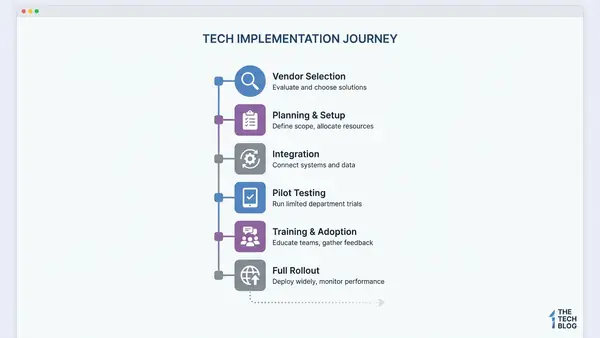
Most key card system failures stem from poor implementation, not technology limitations. Following proven practices prevents the most common pitfalls.
Get written confirmation of compatibility from both your lock vendor and PMS provider before purchasing. Verbal assurances don’t help when systems won’t sync. Request integration documentation and review technical requirements carefully.
Allocate 10-15% of your total project budget specifically for integration work. This covers API development, data mapping, testing, and troubleshooting. Underfunding integration guarantees problems.
Test thoroughly in a sandbox environment for 2-4 weeks before going live. Create test reservations, encode cards, verify access, and confirm that changes in your PMS sync correctly to door locks. Test edge cases like early check-in, late checkout, and multi-room reservations.
Native integrations (same vendor for locks and PMS) cost $0-500 and take 1-3 days. API integrations between different vendors cost $500-3,000 and take 1-2 weeks. Third-party middleware for legacy systems costs $2,000-8,000 and takes 2-4 weeks. Budget accordingly.
Monitor sync logs daily for the first month after go-live. Database synchronization issues often appear gradually rather than immediately. Catching problems early prevents guest complaints and negative reviews.
Train staff on troubleshooting, not just operation. Front desk employees need to diagnose encoding errors, system sync problems, and card reader failures quickly. Create simple flowcharts showing decision trees for common issues.
Equip staff to issue physical backup cards immediately when mobile keys fail. Guests shouldn’t wait while staff troubleshoot Bluetooth settings or app permissions. Solve the immediate problem first, investigate the root cause later.
Send pre-arrival emails explaining mobile key options for guests who want them. Include setup instructions and screenshots. Make it clear that mobile keys are optional and physical cards remain available.
Post simple visual guides at door locks showing exactly how to use cards. “Tap here” with an arrow works better than paragraphs of text. Include a phone number for 24/7 key assistance.
Pilot test new systems on a single floor or wing for 2-4 weeks before property-wide rollout. Include a mix of guest types (business travelers, families, elderly guests) to identify usability issues across demographics. Collect detailed feedback and refine processes before expanding.
Key cards can do more than unlock doors. Strategic implementation extends their value across your property.
Program cards to control elevator access, restricting guests to their assigned floors. This improves security in high-rise properties and prevents unauthorized floor access.
Enable gym, spa, and pool access through the same card. Guests appreciate carrying one card instead of multiple access devices. Your staff benefits from centralized access management.
Integrate key cards with point-of-sale systems for room charges. Guests can charge spa treatments, meals, and minibar purchases directly to their room by presenting their key card. This reduces friction and increases ancillary revenue.
Implement parking garage access through key cards. Properties in urban areas with limited parking can restrict garage entry to registered guests, preventing unauthorized use.
Link key cards to loyalty programs. Encode membership tier information on cards to trigger automatic upgrades, amenity access, or personalized greetings at check-in.
Request customer references with properties similar to yours in size and guest demographics. Ask specific questions about implementation timeline, support responsiveness, and hidden costs that emerged after purchase.
Verify minimum order quantities and lead times. Some vendors require 500-1,000 card minimums. Others offer smaller runs at higher per-unit costs. Plan inventory needs carefully to avoid emergency rush orders.
Confirm ongoing support structure and response times. When your encoding machine fails at 10 PM on Friday, how quickly can you get help? Establish service level agreements in writing before signing contracts.
Review contract terms for firmware updates and system upgrades. Some vendors charge for updates that fix security vulnerabilities. Others include updates in annual support fees. Clarify these costs upfront.
Test sample cards with your actual lock system before placing large orders. Compatibility issues sometimes emerge only during real-world testing. A 10-card sample order costs little compared to discovering problems after receiving 1,000 cards.
Choosing hotel key cards requires balancing upfront costs against long-term operational expenses. RFID cards cost more initially but often deliver lower total cost of ownership through reduced replacement rates and maintenance. Security matters more than many properties realize, with magnetic cards offering virtually no protection against determined attackers. Match your card choice to your property type, with budget hotels potentially justifying magnetic cards while mid-range and luxury properties should prioritize RFID or NFC technology. Implementation quality determines success more than technology choice, so allocate sufficient budget for PMS integration, staff training, and pilot testing.
RFID cards use contactless technology with encrypted chips, while magnetic cards store unencrypted data on a magnetic stripe that must be swiped. RFID cards cost 2-4 times more upfront but last longer, resist demagnetization, and offer better security. Magnetic cards are cheaper initially but fail more often and can be cloned with inexpensive equipment.
Magnetic stripe cards cost $0.08-0.45 per card depending on quality and customization. Standard RFID cards run $0.25-0.50, while advanced encrypted RFID cards cost $0.80-2.00. Wooden eco-friendly cards range from $0.80-5.00. Total cost of ownership including labor, maintenance, and replacements often makes RFID more economical over 5 years despite higher per-card pricing.
Magnetic stripe cards can be cloned in under 30 seconds with $20-100 equipment available online. Legacy RFID cards using Crypto1 encryption were publicly broken in 2008 and remain clonable with $170-400 devices. Modern RFID cards with AES-128 encryption have no publicly known cloning method when properly configured. Security depends entirely on the encryption standard used.
Magnetic cards typically last 3-5 years but hotels replace 25-40% annually due to demagnetization and wear. RFID cards last 3-5+ years with minimal failures, often requiring replacement only when lost or when designs are updated. Wooden cards last 2-4 years depending on usage and environmental conditions. Paper-based eco-friendly cards last only 6-12 months.