Sophia

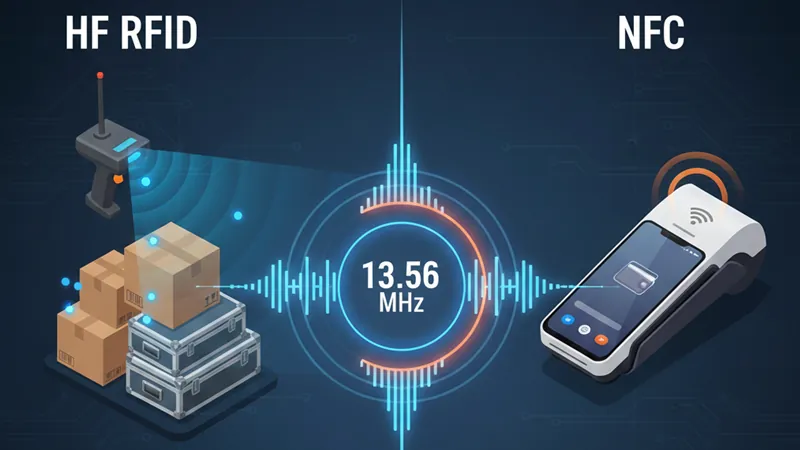
In the contactless tech space, where mobile payments run smoothly and advanced asset tracking works, two terms often blur: HF RFID and NFC. Wondering which fits your business? The answer, unsurprisingly, isn’t a simple “either/or.” It’s a strategic choice based on your specific needs: range, security, and communication type. Key clarity: NFC isn’t standalone technology. It’s a specialized subset and extension of HF RFID, both operate at 13.56 MHz. This deep-dive, tailored for the 2025-2026 tech landscape, demystifies the relationship between these two 13.56 MHz powerhouses.
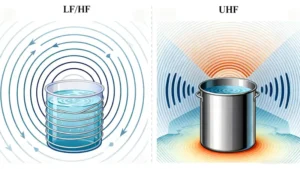
RFID is an umbrella term covering all non-contact, wireless data transfer via radio-frequency electromagnetic fields. It operates across multiple frequencies: Low Frequency (LF), High Frequency (HF), and Ultra-High Frequency (UHF).
HF RFID systems run on the global standard 13.56 MHz frequency. They are the workhorses of short-to-medium-range identification, often complying with standards like ISO/IEC 15693.
NFC is a secure, protocol-strict subset of HF RFID (13.56 MHz, ISO/IEC 18092), enabling two-way interaction for safe data exchange.
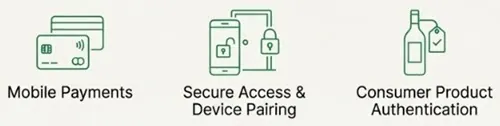
Contactless payment systems like “tap to pay” mainly use NFC. Tap-to-pay bank and credit cards also rely on NFC. Simple passive NFC tags can’t process payments directly, but they can be encoded to trigger payment workflows. For example, opening a URL on a smartphone to start Apple Pay. The tag itself isn’t a payment instrument.
Modern smartphones come with NFC, a specialized subset of HF RFID, for contactless actions like tap-to-pay, reading passive tags and peer-to-peer data exchange. Apple Wallet (including Apple Pay) uses NFC for secure transactions, and only NFC-based high-frequency cards are usually compatible.
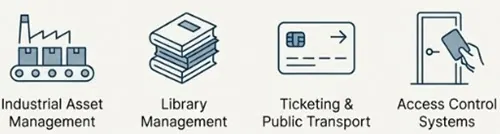
NFC devices can read compliant passive HF RFID tags, but they aren’t suited for bulk reading or long-range tracking (tasks for dedicated HF or UHF RFID readers). RFID isn’t outdated: while NFC leads consumer contactless apps, RFID is vital for logistics, asset tracking and manufacturing. Different frequencies serve modern needs: LF for animal ID, HF for libraries and access systems, and UHF (RAIN RFID) for high-volume inventory and supply chain tracking over distances up to 12 meters.
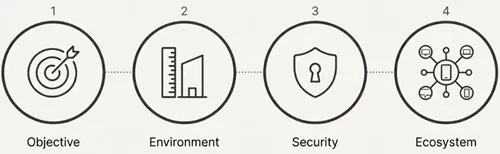
When selecting between HF RFID and NFC, the deciding factor should always be the user experience and the required security posture of your application. Below is an actionable step-by-step strategy for you.
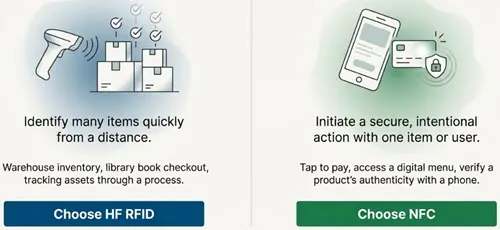
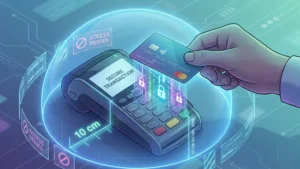
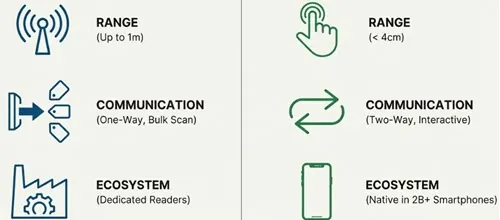
HF RFID’s longer range up to 1 meter enables forklift scanning of warehouse racks. NFC’s enforced proximity under 10 centimeters is a deliberate security feature that prevents unintended reads and enables user consent by presence. In crowded RF environments, NFC’s tighter field is often more robust against interference.
HF RFID tags work well for holding a static ID that references a database. NFC tags and chips however can hold more complex data and often include advanced security features like encryption and password protection. For anti-counterfeiting, secure access or financial transactions, NFC’s architecture is inherently more secure and complex.
NFC is natively built into over 2 billion smartphones worldwide. HF RFID requires proprietary dedicated readers. Ask yourself if you need your solution to interact with consumers’ existing devices. If yes, NFC is your only viable choice.
| Feature | HF RFID | NFC |
|---|---|---|
| Core Standard | ISO 15693, ISO 18000-3 | ISO 14443, ISO 18092 (Builds on HF RFID) |
| Typical Read Range | 10 cm to 1 meter | Less than 10 cm (Usually 3-4 cm) |
| Communication Mode | Primarily One-Way (Reader to Tag) | Two-Way Peer-to-Peer (Device to Device) |
| Data Transfer Rate | Fast (for bulk ID reading) | Slower, but optimized for secure handshake |
| Primary Use Case | Asset Tracking, Inventory, Logistics | Contactless Payments, Access Control, Smart Device Pairing |
| Device Ecosystem | Dedicated Readers & Writers | Integrated in Smartphones & Tablets + Dedicated Readers |
| Security Focus | Minimal to Moderate (Often just a unique ID) | High (Encryption, Secure Elements, User Intent) |
| Cost per Tag | Low | Low to Moderate (for secure chips) |
| 2026 Trend Focus | AI Integration, Sustainability Tracking | Phygital Experiences, Advanced Authentication |
The Pitfall: Underestimating NFC’s protocol complexity and trying to build a secure system on basic HF RFID tags. This leads to easily cloneable tags and system breaches.[1]
The Fix: For any user-facing security-sensitive application, use certified NFC chips with built-in security features. Don’t cut corners.
The Pitfall: Assuming an iPhone can read your warehouse’s ISO/IEC 15693 RFID tags. It can’t. Most phones only read NFC-specific protocols tags like ISO/IEC 14443.
The Fix: Test your specific tag with a phone before finalizing hardware purchases. Understand protocol compatibility.[2]
The Pitfall: Inconsistent read rates from placing tags on metal or liquid-filled objects without proper planning. This destroys ROI.
The Fix: Always conduct a pilot test in the real environment. Use on-metal or specially shielded tags for challenging surfaces. For NFC, clearly mark the tap point with visual cues. [3]
The Pitfall: Deploying a system without plans for data management, reader network health or tag lifecycle. The system decays over time.
The Fix: Treat your deployment as a living system. Assign ownership, monitor performance analytics and establish processes for tag replacement and data audits.
Choosing between HF RFID and NFC isn’t about one being better, it’s about aligning with your business goals. To summarize: opt for NFC for secure, consumer-facing interactions requiring explicit user action (a tap). Choose HF RFID for efficient industrial or enterprise-level tracking and bulk scanning over greater distances. The future of efficient operations and seamless customer experiences runs on 13.56 MHz. Choose wisely.[4]