Sophia


Let’s set the scene. Late at night in Accra, a stolen ambulance speeds down a rain-slicked road. Its license plates? Bent backward. The numbers? Roughly scraped off with a screwdriver. To a human eye, it’s anonymous. But 300 meters ahead, a roadside sensor hums quietly, then pings. Not from the metal. From the chip hidden deep inside.
This isn’t science fiction. It’s Ghana’s near future. On December 15, 2025, the Driver and Vehicle Licensing Authority (DVLA) announced on The Asaase Morning Show that, come 2026, every new license plate will carry an embedded RFID tag (DVLA, 2025). The goal? Smarter tracking, faster crime response, tighter enforcement. But dig a little deeper, and you’ll see this is less about hardware and more about trust, shifting from “hope this plate is real” to “know this vehicle is who it says it is.”
First, production is now fully in-house. Previously, plates were stamped by third-party workshops, creating long, leaky supply chains. Now, design, pressing, and issuance all happen within DVLA facilities. Register in the morning, pick up your plates within 48 hours. This isn’t just convenient, it shuts down the black market for forged plates at its source (DVLA, 2025).

Second, the design itself layers multiple security and identification features. Every plate bears “Republic of Ghana” and the national flag, yes—but also a laser-etched outline of the country’s map. Alphanumeric sequences are randomly generated to prevent prediction. Regional prefixes like “GR” for Greater Accra or “AD” for Ashanti offer instant geographic context. Alone, each element is modest. Together, they form a visual language that’s hard to replicate (DVLA, 2025).
Third, categorization has become sharply defined. Color coding plays a key role: yellow for commercial vehicles and motorcycles, white for private cars, and specialized formats for tricycles, light quadricycles, and trailers. The trailer update is especially significant. For the first time, trailers receive independent registration. That means even if swapped between towing vehicles, a trailer remains traceable (DVLA, 2025). As DVLA Corporate Affairs Director Stephen Attu explains: “A vehicle’s true age lies in its build date, not its registration year” (Attu, 2025). Hence, the registration year is omitted. Instead, all critical data make, model, ownership history, inspection status—lives in the DVLA’s central database, accessible in real time by authorized officers.
If the metal plate is the face, the RFID chip is the nervous system. It transforms verification from visual guesswork into data-driven certainty. Officers can confirm ownership in seconds. Stolen or flagged vehicles trigger automatic alerts as they pass read points. And traffic enforcement? No longer hampered by poor lighting, rain, or deliberate plate obstruction. RFID’s non-line-of-sight capability ensures reliability where cameras often fail (Zhang et al., 2022).
To ensure longevity across Ghana’s varied climate, high heat, heavy rains, intense UV exposure, the embedded RFID components are specified as industrial-grade, engineered for sustained performance under real-world stress (Müller & Schulz, 2024). This isn’t optional polish; it’s baseline reliability. After all, a chip that degrades after three monsoon seasons only deepens public skepticism.
Service delivery is evolving too. The DVLA’s digital portal now supports online pre-registration and appointment booking, easing congestion at service centers. And for vehicles registered before 2023, owners can visit a center to enroll in the biometric-linked vehicle registration system. Upon completion, they receive a smart card storing the vehicle’s full digital profile—streamlining future transactions, inspections, and renewals (DVLA, 2025).
Concerns about enforcement capacity are understandable. But as Attu clarified, the biennial inspection requirement isn’t new policy, it’s mandated under the 2012 Road Traffic Regulations, Legal Instrument 2180, and has been standard practice for over a decade (DVLA, 2025). National fee structures have been approved by Parliament. And critically, with 10 new service centers opening between April and December 2025, DVLA’s operational capacity is now fully aligned with rollout demands.
Ghana isn’t pioneering in isolation. A quiet wave is underway:
Why the convergence? Because RFID solves persistent, real-world problems:
Ghana isn’t pioneering in isolation. A quiet wave is underway:
Notably, early adopters are already moving beyond the plate itself. In high-theft regions, authorities often pair license plate RFID with windshield tags as a secondary verification layer; for critical fleets, mining trucks, refrigerated cargo, emergency vehicles, durable RFID tire tags are becoming essential (HFMA, 2023). Why? Because when a vehicle’s value exceeds the cost of its plate, criminals will remove the plate. RFID industiral tags like tire-embedded tags, however, survive stripping and remain readable, a final line of digital identity (Müller & Schulz, 2024).
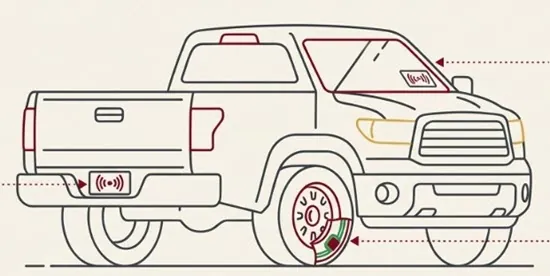
One might wonder: can a tiny chip truly shift paradigms? Consider this. Historically, a vehicle was a physical asset. Increasingly, it’s a digital entity. When every car, truck, or trailer carries a unique, persistent, verifiable ID, new possibilities emerge:
Ghana’s rollout won’t trend on social media. It lacks flashy demos or viral moments. Yet quietly, persistently, it’s doing something profound: transforming anonymous metal into accountable participants in a safer, more efficient system.
As the DVLA urges: “Media support and public cooperation are vital to smooth implementation” (DVLA, 2025). They’re right. Because the future of mobility needs more than good technology. It needs good trust—a social contract built on transparency, reliability, and verifiable truth.