Sophia

A major university recently completed the procurement phase for its new library system, awarding a multi-million-dollar contract for RFID integration. The component list provides a crucial, itemized blueprint for any organization seeking to quantify the cost and hardware requirements of a large-scale smart library deployment.
This procurement mandates a unified Ultra-High Frequency (UHF) architecture. This choice signals a clear priority: maximum speed, remote reading capability, and high-volume circulation processing over traditional High-Frequency (HF) systems. This detailed list serves as a checklist for calculating project feasibility and estimating initial Capital Expenditure (CapEx).
The RFID tag is the foundational unit. Its cost and type determine initial investment and long-term performance.
| Equipment (UHF) | Quantity | Function and CapEx Assessment |
|---|---|---|
| RFID Book Tags (TD-BQ-10) | 320,000 units | Digital Identity. This is the largest CapEx item. Every physical asset requires one tag. The total quantity scales with the existing collection size plus projected growth. Tags must adhere to the UHF EPC Gen 2 protocol for compatibility. |
| RFID Shelf Tags (TD-BQ-06) | 8,000 units | Infrastructure Tagging. These tags identify the fixed location of every shelf. Mobile readers scan these tags and cross reference book tags, enabling automatic detection of misfiled books. |
Procurement Implication: The sheer volume dictates a low cost, high reliability UHF solution. Costs for tag secondary processing (encoding data and memory locking) must be factored into the final CapEx.
This hardware module addresses the two primary efficiency failures of manual systems: long checkout queues and protracted inventory cycles.
| Equipment (UHF) | Quantity | Operational Value and Throughput Gains |
|---|---|---|
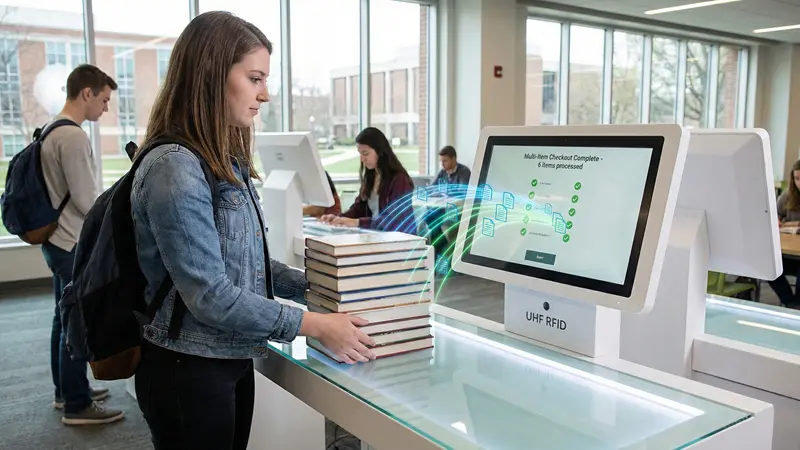
| RFID Self-Checkout Kiosks | 4 units | Throughput Optimization. Readers allow patrons to place stacks of books (multi tag reading) for simultaneous checkout. This immediately reduces peak-hour queuing, cutting transaction time to seconds. |
| Custom UHF Self-Checkout (Professional) | 4 units | Specialized Functions. These customized units meet high security access requirements or specialized resource handling needs. |
| UHF Mobile Rechargeable Inventory Reader (PD-DP-05) | 2 units | Labor Savings. Staff use the mobile unit to perform non-contact inventory scanning. The time required for full collection inventory shifts from weeks to hours or days. |
| Staff Workstation Integrated Machine | 7 units | Data Management & Enrollment. These stations are essential for new book processing, tag programming, data synchronization with the central database, and handling exceptions. They automate data entry, reducing labor costs and error rates. |
This module defines the perimeter defense and the central software platform that transforms data into management decisions.
The security equipment provides perimeter defense and high-fidelity traffic data collection.
The software suite delivers the primary Return on Investment by converting hardware data into actionable intelligence.
The successful deployment requires tightly integrating all hardware and software components into a cohesive ecosystem. The total investment in this UHF project validates a commitment to performance over traditional methods. The system architecture divides hardware into clear functional tiers: high-volume data capture (Tags), rapid patron processing (Kiosks), reliable theft prevention (Security Gates), and centralized process management (Software). This blueprint outlines the essential components that form the framework for a high-volume smart library system, providing clear context for project costs and required tools.
| System Module | Primary Hardware Component | Quantity | Core Operational Function |
|---|---|---|---|
| Tagging & Inventory Foundation | UHF RFID Book Tags | 320,000 units | Enable non-contact, unique item identification. |
| Circulation & Autonomy | UHF Self-Checkout Kiosks (Standard & Custom) | 8 units | Automate high-volume book borrowing; eliminate patron queuing. |
| Inventory Management | UHF Mobile Rechargeable Inventory Reader | 2 units | Execute full collection inventory in hours/days; detect mis-shelving. |
| Security Perimeter | UHF RFID Security Gate | 4 units | Provide perimeter theft defense (electronic article surveillance). |
| Access & Authentication | Smart Turnstile Gates / Facial Recognition Readers | 14 units (each) | Control patron flow and secure entry through multi-factor ID check. |
| Central Intelligence | Cluster Management System / Big Data Platform | 1 set (each) | Convert hardware data into circulation history and scientific procurement reports. |
This list, valued at over $3.7 Million for hardware and software procurement alone, serves as a comprehensive feasibility and cost assessment tool for any institution planning a similar migration.